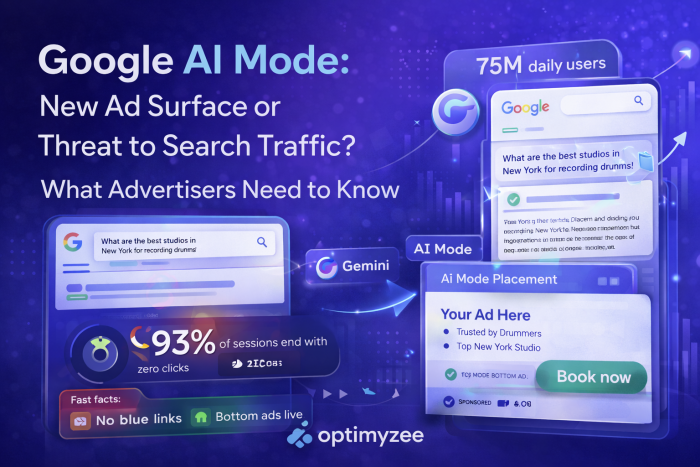
Quick Answer: Google AI Mode is a fully conversational search experience powered by Gemini that now has 75 million daily active users. It replaces the traditional results page entirely – no ten blue links, just AI-generated answers. 93% of AI Mode sessions end without a click to any external site. However, Google has already built complete ad infrastructure inside AI Mode, with a new placement called ‘AI Mode Bottom Ads’ operational in the background. Advertisers using Performance Max or AI Max for Search are most likely to appear there first. This post explains what AI Mode is, what the ad opportunity looks like right now, and what to do to be ready.
Something shifted in how people use Google in 2025. The traditional search experience – type a query, scan ten blue links, click the most relevant one – is still available. But a growing number of users are choosing something different: a fully conversational search mode that answers complex, multi-step questions through an ongoing dialogue with AI.
That experience is Google AI Mode. It launched in limited availability in May 2025, expanded globally through late 2025, and as of early 2026, processes over one billion queries per month. It has reached 75 million daily active users – one of the fastest adoption rates for any new search feature in Google’s history.
For advertisers, AI Mode is simultaneously the clearest signal yet of where search is heading and the most uncertain surface to plan around. This post separates what is confirmed from what is speculative, explains the organic and paid implications, and gives you a practical framework for being ready.
What Is Google AI Mode and How Does It Differ from AI Overviews?
The confusion between AI Overviews and AI Mode is widespread – even among experienced advertisers. They are distinct experiences with different implications.
AI Overviews appear at the top of a traditional Google search results page. Below the AI-generated summary, the standard results page still exists – organic links, paid ads, maps, shopping units. AI Overviews modify the existing search experience. They appear for approximately 48% of all Google queries as of March 2026 (BrightEdge), and ads appear alongside them in 25.5% of those results.
AI Mode replaces the traditional results page entirely. There are no ten blue links. The experience is fully conversational – users can ask multi-step follow-up questions, request comparisons, and drill into specifics through ongoing dialogue. It is Google’s equivalent of ChatGPT’s search functionality, but powered by Gemini and integrated directly into Google Search.
🔍 The strategic distinction matters for advertisers: AI Overviews modify existing search behaviour – users still see organic results and ads beneath the AI summary. AI Mode eliminates the organic results page entirely for users who choose it. Organic SEO visibility in AI Mode depends entirely on whether the AI cites your content. For paid search, ad placement in AI Mode is a new frontier, not an extension of existing placements.
The January 2026 update that lets users jump directly from an AI Overview into an AI Mode conversation creates a funnel: standard search → AI Overview → AI Mode. Users moving down that funnel are increasingly insulated from both traditional organic results and standard search ads.
Sources: BrightEdge (AI Overviews coverage March 2026), Digital Applied ‘Google AI Mode: 75M Users, Ads in 25% of AI Results’ (March 2026)
Scale and Adoption in 2026
The growth of AI Mode has been rapid enough that it can no longer be treated as an experimental feature that might not reach mainstream scale:
- 75 million daily active users by late 2025 (confirmed by Google’s Nick Fox, December 2025)
- 100+ million monthly active users across US and India markets
- Over 1 billion monthly queries processed as of early 2026
- 53 new languages added in March 2026, making it relevant for advertisers in non-English markets
- Users spend 49 seconds on average in AI Mode per session, versus 21 seconds in AI Overviews (Growth Memo, October 2025)
- Time spent comparing brands or products in AI Mode: 77 seconds on average
The engagement data is particularly significant. Users who engage with AI Mode are spending more time with Google’s AI-generated content than with any previous search feature. They are not bouncing – they are researching. This creates both the zero-click challenge (they get answers without visiting sites) and the advertising opportunity (high-intent research sessions with commercial relevance).
Source: Semrush ‘Google AI Mode’ analysis (February 2026), Growth Memo AI Mode engagement data (October 2025)
The Zero-Click Problem: What 93% Means for Traffic
Seer Interactive’s study of 25.1 million impressions found that 93% of AI Mode sessions end without a single click to an external website. This is significantly higher than the 43% zero-click rate for AI Overviews in standard search.
For businesses dependent on organic search traffic, this number is alarming. For advertisers, the picture is more nuanced.
The 93% figure reflects the nature of queries that currently drive AI Mode usage. Most are informational, research-phase, or comparative – the kind of queries that rarely converted into immediate clicks even in traditional search. Someone asking AI Mode “what’s the difference between Target ROAS and Maximize Conversion Value in Google Ads?” was not about to click an ad or make a purchase from that query regardless of format.
⚠️ The relevant question for advertisers is not ‘what is the overall zero-click rate?’ but ‘what is the zero-click rate for the commercial queries that matter to my business?’ For high-intent transactional queries – ‘buy X’, ‘X near me’, ‘X price’ – AI Mode currently shows at much lower rates. These queries remain predominantly in standard search, where traditional paid placements still dominate.
The longer-term risk is query migration. If Google’s AI Mode becomes the default research interface for an increasing share of users – particularly for the comparison and consideration-phase research that precedes high-intent searches – advertisers will eventually need to capture those research sessions, not just the final purchase intent query.
Source: Seer Interactive 25.1 million impressions study, Digital Applied analysis (March 2026)
The Ad Infrastructure Already Inside AI Mode
The most important data point for advertisers planning ahead comes from technical analysis rather than official announcements. In January 2026, Discovered Labs analysed network traffic from 547 Google AI Mode sessions and over 1,300 total requests. The findings are significant:
- Google runs complete ad delivery, tracking, and attribution systems in the background of every AI Mode session – even though ads are not visibly displayed in most responses yet
- A new placement called ‘AI Mode Bottom Ads’ (codenamed ‘aimba’) has fully operational infrastructure ready to show ads below AI-generated answers
- Ad auctions happen server-side within 60 milliseconds of a query – before the AI response finishes generating, which takes 6+ seconds
- Query-to-conversion attribution is already tracking user journeys through AI Mode via a parameter called adview_query_id
- Shopping and product listing ad code appears extensively in AI Mode JavaScript bundles – 2,422 matches for ‘shopping_ads’ patterns in the codebase
- Users clicking through from AI citations to websites are already being added to remarketing audiences
🔍 The infrastructure analysis reveals that Google has essentially pre-built the monetization layer for AI Mode. Ad auctions are already running silently. The ’empty’ ad slots returning [null,null,…,0] in January 2026 are placeholders waiting to be filled. This is not a future product being designed – it is an existing product with the revenue switch not yet flipped to full deployment.
Source: Discovered Labs ‘How Google AI Mode Ads Work Today and What They Might Look Like Tomorrow’ (January 2026) – analysis of 547 AI Mode sessions
How Ads in AI Mode Currently Work
What’s live now
Google is actively testing ads in AI Mode in the United States. The evidence comes from multiple sources including direct confirmation from Google’s VP of Retail Ads, Courtney Rose, who told Modern Retail in April 2026 that ‘we’re seeing great performance’ from early AI Mode ad tests.
Rose cited Aritzia, a fashion retailer, as a case study: when they enabled AI Max for Search, they appeared across AI Mode as well as traditional search experiences and saw an 80% increase in revenue. The mechanism: AI Max learns what the retailer sells and what their creative assets show, then matches them to relevant conversational queries – including in AI Mode sessions.
Direct Offers
Google is testing a format called ‘Direct Offers’ inside AI Mode – personalised promotions shown to users who display purchase intent signals within a conversational session. Using Gemini models to analyse conversational context, the system identifies moments when a promotion is likely relevant and surfaces it directly in the AI response. Early adopters include Poshmark and Reebok, alongside AI Mode’s broader commerce features.
The eligibility requirements
Based on available evidence from Google’s documentation and industry reporting, appearing in AI Mode ad placements requires:
- Performance Max or AI Max for Search campaigns:
These are Google’s stated vehicles for AI Mode placement. Standard keyword-targeted Search campaigns without broad match or AI Max enabled are not eligible. Google’s Courtney Rose confirmed: ‘When you use AI products like AI Max or Performance Max, you’re able to surface across all of these experiences for the consumer, including AI Mode.’
- Ad content and landing page relevance to the AI answer:
Unlike standard search where relevance is measured against a keyword, AI Mode requires relevance to the content of the AI-generated answer. An ad for a product that appears in an AI Mode response must be relevant not just to the query, but to the specific context and recommendations the AI has generated. Short, minimal landing pages likely do not qualify.
- Broad match or keywordless targeting:
Without these, campaigns are not eligible for AI Mode placements. The AI needs the flexibility to match ads to conversational queries that do not map to exact keywords.
💡 The implication for advertisers: if you are running lean Search campaigns with only exact and phrase match keywords and a minimal landing page, you are currently excluded from AI Mode placements. Enabling AI Max or Performance Max with strong landing page content is the prerequisite for eligibility.
Sources: Modern Retail interview with Courtney Rose, VP Retail at Google Ads (April 2026), WordStream ‘Google Ads in AI Mode’ (December 2025), Google official documentation
What Advertisers Should Do Right Now
AI Mode advertising is in early stages – most advertisers will not see dramatic changes to their existing campaigns in the next 60 days. But the steps that position you for AI Mode eligibility are the same steps that improve performance on existing surfaces. There is no downside to taking them now.
1. Enable AI Max for Search on your highest-volume campaigns
This is the clearest path to AI Mode eligibility confirmed by Google. Use the built-in 50/50 experiment to test without risking your full campaign budget. Run for 3–4 weeks and review conversion data before scaling.
2. Audit your landing page quality
AI Mode requires ad content and landing page content to be relevant to AI-generated answers – not just to a keyword. This means your landing pages need substantive, accurate content about what you sell. Pages with thin copy, minimal information, or aggressive conversion-optimisation tactics that sacrifice content quality are likely ineligible. Review your top landing pages against this standard.
3. Implement or verify Performance Max campaigns
PMax campaigns are Google’s primary vehicle for cross-surface ad delivery including AI Mode. If you are not running PMax, or if your current PMax setup is outdated, now is the time to review. Particularly important: ensure Search Themes are set, brand exclusions are active, and asset quality is high.
4. Build remarketing audiences from AI Mode traffic now
According to Discovered Labs’ technical analysis, users who click from AI Mode citations to your website are already being added to your remarketing audiences. This is happening right now, before paid AI Mode placements are widely deployed. Build and segment these audiences so you have a warm pool to target when AI Mode ad formats expand.
5. Monitor branded search volume as an AI citation proxy
Organic citations in AI Mode drive branded search uplift – users who see your brand cited in an AI answer then search for you directly. Track branded search impression volume in Google Search Console as an early signal of AI Mode citation frequency, even before direct AI Mode reporting is available.
🚨 One thing to avoid: over-rotating your entire paid search strategy toward AI Mode at the expense of proven placements. AI Mode represents a growing but still minority share of Google queries. Standard search, AI Overviews, and Shopping remain the dominant performance channels for most advertisers in 2026. AI Mode readiness is an investment in the next 12–24 months, not an emergency pivot.
The Organic Angle: Getting Cited vs Getting Clicked
For advertisers who also manage SEO, AI Mode creates a new metric that matters: citation frequency. Unlike standard search where ranking position directly correlates with CTR, AI Mode cites sources within its answers – and those citations drive branded search uplift even when users do not click through directly.
Semrush’s research shows that pages cited in AI Mode see increased branded search activity even when direct clicks are not captured. The SEO implication: optimise content to be AI-citeable – structured, factual, modular – not just to rank in traditional results. The advertising implication: your content marketing and SEO efforts directly feed the ecosystem in which your paid ads appear in AI Mode.
📌 The full-stack strategy for AI Mode: invest in content that earns organic citations (brand visibility without clicks), while simultaneously ensuring your paid campaigns are eligible for the commercial placement layer that Google is building on top. Both feed each other.
FAQ
Do I need to take any action today to appear in AI Mode ads?
The most impactful action is enabling AI Max for Search on existing campaigns, either as a full rollout or via Google’s built-in experiment mode. Performance Max campaigns are also eligible. Ensure your landing pages have substantive content and that you are using broad match or keywordless targeting. These steps improve performance on current placements and position you for AI Mode eligibility as the format expands.
Will AI Mode replace traditional Google Search?
Not in the near term, and possibly not even in the medium term. AI Mode requires users to actively change their behaviour – selecting a different tab rather than using the standard search box. Adoption is growing fast, but it remains a minority of total Google queries. The more immediate change is AI Overviews appearing in standard search results, which affects 48% of all queries. AI Mode represents the longer-term structural shift; AI Overviews are the present-day challenge.
My campaigns are performing well. Should I worry about AI Mode?
Campaigns focused on high-intent transactional queries – ‘buy X’, ‘X price’, ‘X near me’ – are least affected in the near term because these queries rarely trigger AI Mode. Campaigns that rely on informational and research-phase traffic are more exposed, because AI Mode is best suited to complex, multi-step research queries. Audit your Search Term Report for the query intent mix in your top campaigns to assess your specific exposure.
Can organic content in AI Mode reduce the need for paid ads there?
Partially. Getting cited in AI Mode responses increases brand visibility and drives branded search volume – both of which support paid search performance through the halo effect. However, Discovered Labs’ technical analysis confirmed that organic citations and paid ad placements run through entirely separate systems in AI Mode. There is no evidence that organic citation quality influences paid ad eligibility. You need both – organic citations for upper-funnel visibility and paid placements for commercial intent capture.
What is the ‘Direct Offers’ format in AI Mode?
Direct Offers is an experimental ad format being tested inside AI Mode that presents personalised promotions to users who show purchase intent signals within a conversational session. Google’s Gemini models analyse the conversation context to identify when a promotion is likely relevant. Early testers include Poshmark and Reebok. The format is not widely available as of May 2026 – it is part of Google’s broader Universal Commerce Protocol initiative. Watch for broader rollout announcements at Google Marketing Live, scheduled for May 21, 2026.
The Bottom Line
Google AI Mode is not a threat to paid advertising. It is the next surface for paid advertising. The difference between those two framings is significant: advertisers who treat AI Mode as a disruption to manage will be reactive. Advertisers who treat it as new inventory to qualify for will be positioned ahead.
The steps to AI Mode eligibility – AI Max for Search, Performance Max, high-quality landing pages, substantive content – are the same steps that improve performance on every existing Google surface. There is no unique strategy required for AI Mode today. There is simply good paid search practice that happens to also prepare you for what is coming.
The timeline for significant impact on advertising performance is likely 2026–2027 as AI Mode adoption grows and Google expands the ‘AI Mode Bottom Ads’ placement from testing to general availability. The time to build readiness is now, while the investment is low and the competition for these placements is not yet intense.
→ Want to ensure your Google Ads campaigns are structured to perform on current surfaces and AI-era placements? Optimyzee analyses your campaign architecture and keyword organisation to identify structural gaps before they become performance problems.
Sources
Digital Applied: ‘Google AI Mode: 75M Users, Ads in 25% of AI Results‘ (March 2026)
Discovered Labs: ‘How Google AI Mode Ads Work Today and What They Might Look Like Tomorrow‘ – technical analysis of 547 AI Mode sessions (January 2026)
Modern Retail: ‘Google Says Its AI-Powered Ads Help Some Brands Lift Online Sales by 80%‘ – interview with Courtney Rose, VP Retail Google Ads (April 2026)
WordStream: ‘Google Ads in AI Mode: Here’s What We Know‘ (December 2025)
Seer Interactive: Study of 25.1 million impressions – 93% of AI Mode queries end without a click
BrightEdge: AI Overviews coverage tracking – 48% of queries, March 2026
Semrush: ‘What Is Google AI Mode? (+How to Optimize for It in 2026)’ (February 2026)
Growth Memo: AI Mode engagement data – 49 seconds average session, October 2025
Search Engine Land: ‘Google Outlines AI-Powered, Agent-Driven Future for Shopping and Ads in 2026′ (February 2026)
Google Ads Help: ‘Google Ads Highlights of 2025‘ – AI Max and Demand Gen performance data