Quick answer: Demand generation is the set of marketing programs that build awareness of, and interest in, your product before anyone is ready to buy. It relies mostly on ungated content, such as articles, videos, and public resources, and on channels like SEO, paid media, events, and partnerships. Lead generation is one part of it: the step where interested people hand over contact details so sales can follow up. Demand generation creates the interest, and lead generation captures it.
What is demand generation?
Oracle describes demand generation as using targeted marketing programs to raise awareness and build interest in a brand and its offerings. The key word is interest. The goal isn’t to collect an email address on the first visit. It’s to make sure that when a buyer starts looking for a solution, your company is already familiar and trusted.
It also doesn’t stop at the first sale. Demand generation covers the whole customer lifecycle, from the first time someone hears about you through repeat purchases, upgrades, and recommendations to others.
Demand generation vs lead generation
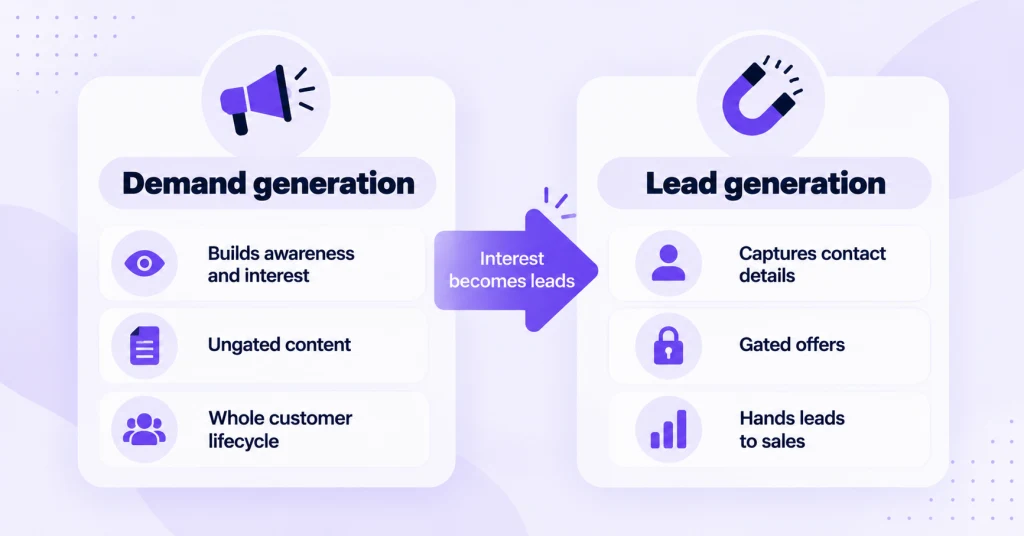
The two terms are often used as if they mean the same thing, but they do different jobs.
- Demand generation aims to raise awareness and interest. It leans on ungated content that anyone can read or watch without filling in a form.
- Lead generation aims to identify prospects and turn them into sales leads. It leans on gated offers, such as webinars, demos, or reports, in exchange for contact details.
Oracle treats lead generation as one component of a broader demand generation strategy, and the two work best together. Demand generation builds the interest, and lead generation converts it. A company that only does lead generation keeps asking a small pool of already-interested people for their email. A company that only does demand generation builds awareness but never gives interested buyers a clear next step.
The stages of a demand generation strategy
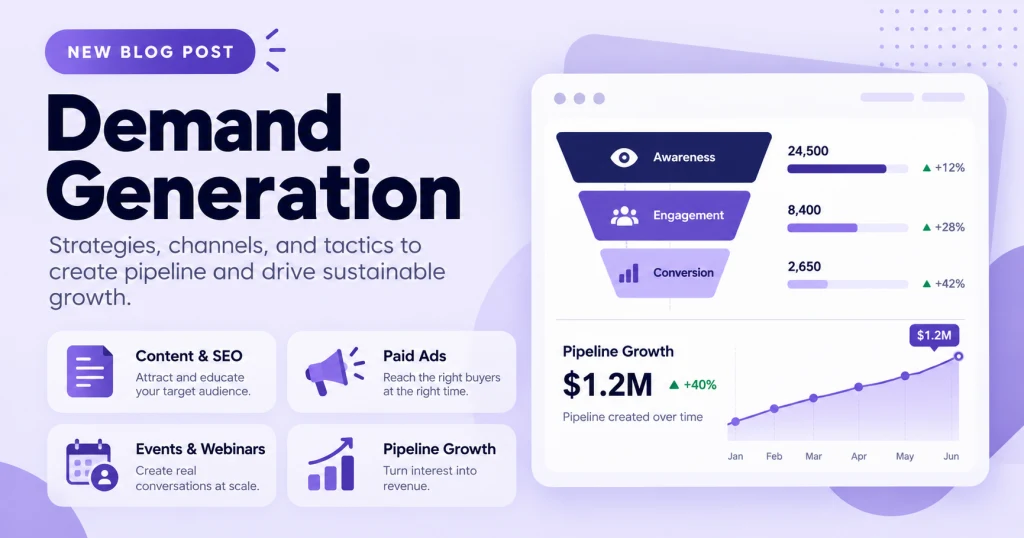
A common way to organise the work is as a five-stage framework, each stage with its own tactics:
- Awareness: make your target market aware you exist, through SEO content, paid social and display, events, and PR.
- Engagement: educate prospects before they’re ready to buy, through email nurture, retargeting, webinars, and community.
- Conversion: turn engaged prospects into sales opportunities, through bottom-funnel content, demo or trial flows, and intent-based outreach.
- Expansion: grow existing accounts through upsells, cross-sells, and customer marketing.
- Advocacy: turn customers into a growth channel through case studies, referral programs, and reviews.
Demand generation channels
No single channel does everything. Each fits a different situation:
- Content marketing and SEO: suits long sales cycles and higher-priced products, because it keeps working long after it’s published.
- Paid media (search and social): suits categories buyers already understand, where intent signals are clear.
- Events and webinars: suit relationship-driven and enterprise sales.
- Partnerships and co-marketing: suit complementary products that share an audience.
- Product-led growth: suits self-serve products that deliver value quickly, such as a free trial.
Demand creation vs demand capture
It helps to separate two jobs that often get mixed up. Demand creation makes people aware of a problem or a solution they weren’t actively looking for, using content, social, events, and brand-building. Demand capture reaches people who are already searching, and paid search is the clearest example.
Both matter. Capture without creation runs out of people to capture. Creation without capture leaves interested buyers with no easy way to find you. If you’re running paid search to capture demand, the efficiency of that spend matters a lot, which is why we’ve written about reducing PPC costs and finding wasted budget in search terms.
How to measure demand generation
Demand generation is harder to measure than a single click, because its effect shows up over weeks or months and across several touchpoints. A practical setup tracks three layers:
- One north-star metric: pick either pipeline velocity or CAC payback period, and judge the whole program against it.
- Leading indicators, checked weekly: MQL-to-SQL conversion rate, opportunity creation rate, and how deeply people engage with your content.
- Lagging indicators, checked monthly: win rate by source, customer lifetime value by acquisition channel, and pipeline attribution.
All of this depends on tracking that works. If conversions are missing or double-counted, every number above will mislead you. Our guide to Google Ads conversion tracking covers the paid search side of that foundation.
Demand generation vs Google Demand Gen campaigns
The names are similar, but they’re not the same thing. Demand generation is the broad marketing discipline described in this article. Demand Gen campaigns are a specific Google Ads campaign type used to reach people across YouTube, Discover, and Gmail. A Google Demand Gen campaign can be one tactic inside a demand generation strategy, but a demand generation strategy is much bigger than any single campaign type.
Where demand generation fits with other marketing approaches
Demand generation overlaps with several terms you may already use. Performance marketing focuses on paid, trackable actions and mostly converts demand that already exists. Growth marketing is wider, including product, retention, and referral loops. Demand generation sits across both: it includes the awareness and education work that performance channels depend on, and it feeds the pipeline they convert.
Common mistakes
- Gating everything. Putting every resource behind a form shrinks your audience before it has a reason to trust you.
- Measuring only last-click. Content and awareness work rarely gets credit in a last-click report, so it looks useless on paper even when it’s feeding pipeline.
- Skipping sales alignment. If marketing and sales define a “qualified” lead differently, handoffs break and good leads go cold.
- Expecting quick results. Content and brand programs take time to compound. Judging them after two weeks usually means cutting them too early.
FAQ
What is the difference between demand generation and lead generation?
Demand generation builds awareness and interest, mostly through ungated content. Lead generation captures contact details from interested people, usually through gated offers, so sales can follow up. Lead generation is one part of a wider demand generation strategy.
Is demand generation only for B2B?
No. The term is most common in B2B, where sales cycles are long and several people are involved in a purchase, but the same idea of building interest before a buyer is ready applies to B2C too.
What are examples of demand generation?
SEO blog content, webinars and events, podcasts, social media, public research or reports, paid social and search ads, partnerships and co-marketing, and customer case studies and referral programs.
How long does demand generation take to work?
It depends on the channel. Paid search can produce results within days, while content, brand, and community programs usually take months to build momentum. That’s why most strategies combine fast and slow channels.
What metrics should I track for demand generation?
Choose one north-star metric, such as pipeline velocity or CAC payback period, then track leading indicators like MQL-to-SQL conversion weekly and lagging indicators like win rate by source and lifetime value by channel monthly.
Sources
- Oracle: What is Demand Generation?
- Chief Marketer: Demand Generation vs. Lead Generation: What Marketers Must Know
- MarketerHire: B2B Demand Generation Strategy: Build a Repeatable Pipeline