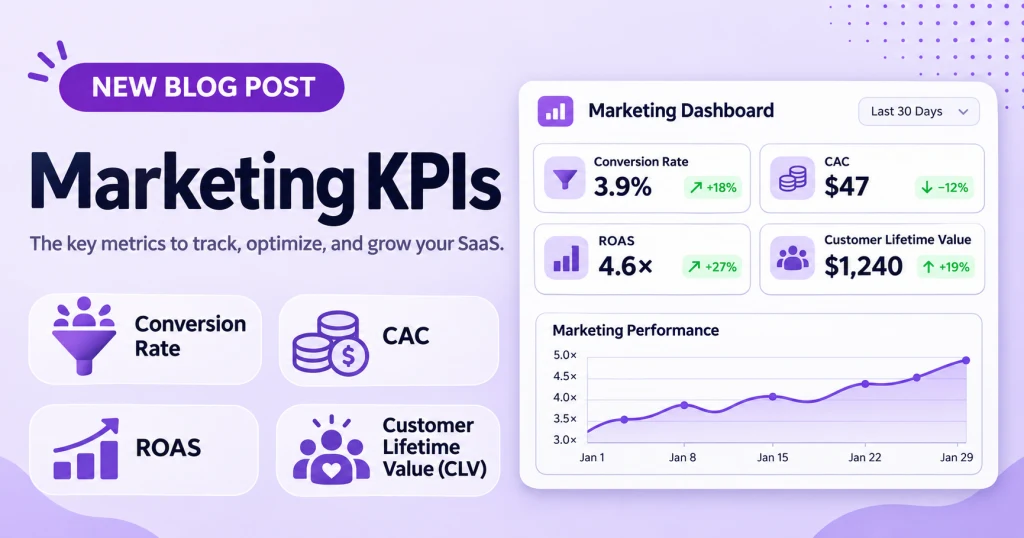
Quick answer: Marketing KPIs (key performance indicators) are the small set of metrics that tie directly to a business goal, so that a change in the number matters for the business. A metric is anything you can count, such as visits or clicks. A KPI is a metric you’ve chosen to judge success by. The core KPIs most teams use are conversion rate, cost per lead, customer acquisition cost (CAC), return on ad spend (ROAS), return on investment (ROI), and customer lifetime value (LTV).
Marketing KPIs vs marketing metrics
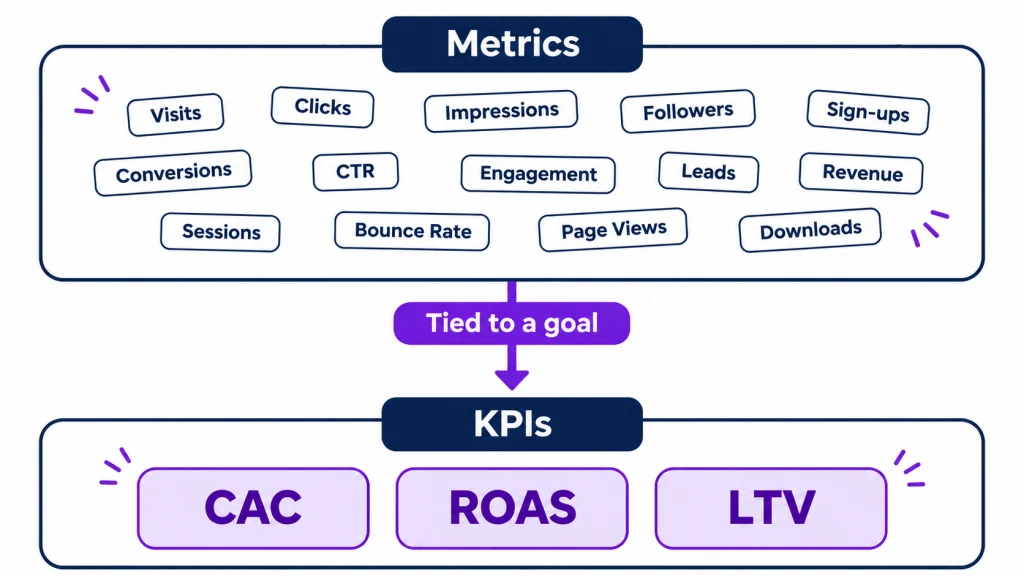
The two terms are often swapped, but they aren’t the same thing. A metric is any number you can count: visits, clicks, impressions, leads. On its own, it has no fixed meaning. A KPI is a metric tied to a goal, so a change in it matters for the business.
KPIs are few and aligned with your objectives. Metrics can be numerous and mostly serve as supporting data that helps explain why a KPI moved. Clicks, for example, are a useful metric, but if your goal is profitable growth, they’re not the goal itself.
How to choose your marketing KPIs
- Start from the goal, not the tool. If the goal is profitable growth, the KPIs are ROI, CAC, and LTV. Impressions and clicks help explain changes in them, but they aren’t goals.
- Use one KPI per question. ROI answers “are we making money?” ROAS or CAC by channel answers “where should we spend?” Retention or churn answers “do customers stay?”
- Match your business model. Subscription businesses need MRR, churn, and payback time. Online stores need conversion rate, cart abandonment, and average order value.
- Define each KPI in writing. Say which costs, orders, and time periods count, so everyone reports the same number.
Core marketing KPIs and formulas
| KPI | What it tells you | Formula |
|---|---|---|
| Conversion rate | Share of visitors who complete a desired action | Conversions ÷ visitors × 100 |
| Click-through rate (CTR) | Share of people who see an ad or link and click it | Clicks ÷ impressions × 100 |
| Cost per click (CPC) | Average cost of each ad click | Ad cost ÷ clicks |
| Cost per action (CPA) | Cost of a defined action, such as a sign-up | Ad cost ÷ completed actions |
| Cost per lead (CPL) | Cost of acquiring a lead’s contact details | Ad cost ÷ leads |
| Customer acquisition cost (CAC) | Average cost to win one new customer | Marketing and sales cost ÷ new customers |
| Return on ad spend (ROAS) | Revenue earned per unit of ad spend | Ad revenue ÷ ad cost |
| Return on investment (ROI) | Gain relative to cost; should be above 0% | (Return − cost) ÷ cost × 100 |
| Customer lifetime value (LTV) | Value a customer brings over the relationship | Average order value × purchase frequency × customer lifespan |
| LTV:CAC ratio | Customer value relative to acquisition cost | LTV ÷ CAC |
| Marketing efficiency ratio (MER) | Total revenue relative to total marketing spend | Total revenue ÷ total marketing spend |
| Churn rate | Share of customers lost in a period | Customers lost ÷ customers at start × 100 |
| Customer retention rate | Share of starting customers who stay | ((Customers at end − new customers) ÷ customers at start) × 100 |
For a closer look at one of the most-used paid KPIs, see our ROAS calculator and guide.
Marketing KPIs by goal
Lead generation and conversion
Track the number of marketing-qualified leads (MQLs), the share that sales accepts as sales-qualified leads (SQLs), cost per lead, and the lead-to-customer conversion rate. These show whether the leads you’re paying for are the ones sales can actually close. This is closely related to the work covered in our guide to demand generation.
Paid media efficiency
For paid campaigns, the working set is CTR, CPC, CPA, and ROAS. They show how efficiently each channel turns spend into results. Our guide to checking campaign efficiency on Google Ads shows how to read these inside an account, and performance marketing explains why they’re the headline numbers for paid channels.
Subscription and SaaS
Subscription businesses add MRR (monthly recurring revenue), ARPA (average revenue per account), CAC payback time, revenue churn, and Net Promoter Score (NPS). We cover how these fit together in our SaaS marketing guide.
Engagement and awareness
Reach, impressions, ad frequency, bounce rate, session duration, and branded search volume help show whether people are noticing and engaging with you. They’re usually supporting metrics rather than top-level KPIs, unless awareness is the explicit goal of a campaign.
Common mistakes with marketing KPIs
- Tracking too many. A dashboard with 40 numbers hides the three that matter. Pick a few KPIs per goal.
- Choosing vanity metrics. Impressions and follower counts are easy to grow but may not connect to revenue.
- Not defining the KPI. If one team counts a lead differently from another, the numbers won’t match and nobody trusts them.
- Relying on bad tracking. Every KPI above depends on accurate conversion data. See our guide to Google Ads conversion tracking.
- Reading a single number alone. A falling CPA looks good, but not if lead quality dropped at the same time. Read KPIs in pairs.
FAQ
What is the difference between a KPI and a metric?
A metric is any number you can measure. A KPI is a metric chosen because it’s tied to a business goal. All KPIs are metrics, but most metrics are not KPIs.
How many marketing KPIs should I track?
Few. A handful per goal is usually enough, with supporting metrics beneath them to explain changes. If you can’t say which decision a number informs, it probably isn’t a KPI.
What are the most important marketing KPIs?
It depends on your goal and business model. For profitable growth, ROI, CAC, and LTV matter most. For paid channels, ROAS and CPA. For subscriptions, MRR, churn, and CAC payback.
What is a good marketing ROI?
ROI should be above 0%, which means you earned back more than you spent. Beyond that, what counts as good depends on your margins, your sales cycle, and what else the money could have done.
How often should I review marketing KPIs?
It depends on the KPI. Fast-moving paid media numbers are often reviewed weekly, while retention, LTV, and payback are usually reviewed monthly or by cohort over a longer window.
Sources
- OWOX: Digital marketing metrics and KPIs
- Klipfolio: Marketing Metrics and KPIs