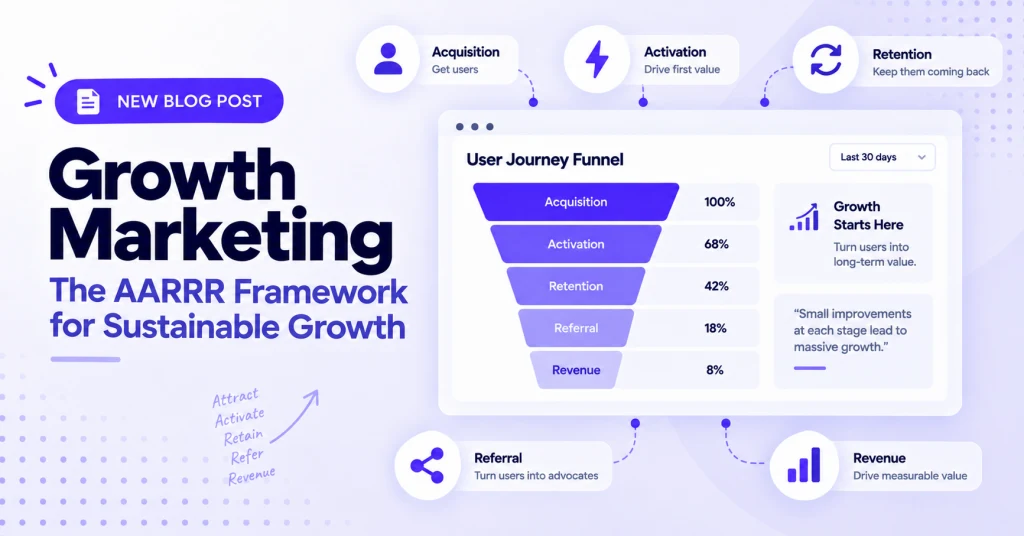
Quick answer: Growth marketing is a data-driven approach that uses rapid experimentation across the entire customer journey, acquisition, activation, retention, referral, and revenue, rather than focusing only on getting new customers in the door. Where traditional marketing often stops at awareness and acquisition, growth marketing treats the whole funnel as fair game for testing and optimisation, borrowing tactics like A/B testing, SEO, referral programmes, and paid channels wherever the data points.
What is growth marketing?
Growth marketing is marketing built around continuous experimentation rather than a single planned campaign. Instead of launching one creative direction and running it for a quarter, growth teams run small, fast tests, on messaging, channels, onboarding flows, pricing pages, whatever the data suggests is worth testing, and double down on what works.
The defining shift from traditional marketing is scope. Traditional marketing tends to concentrate on the top of the funnel: awareness and acquisition. Growth marketing treats the entire customer lifecycle as its territory, including what happens after someone becomes a customer.
Growth marketing vs traditional marketing
- Traditional marketing plans a campaign, executes it as designed, and measures results afterward. It’s typically concentrated on awareness and top-of-funnel acquisition.
- Growth marketing treats every stage of the customer journey, including retention and referral, as something to be tested and improved continuously, using real-time data to redirect effort rather than waiting until a campaign ends to learn from it.
Neither approach replaces the other entirely, most mature marketing teams run planned brand and campaign work alongside a growth function that’s constantly testing and iterating underneath it.
The AARRR framework
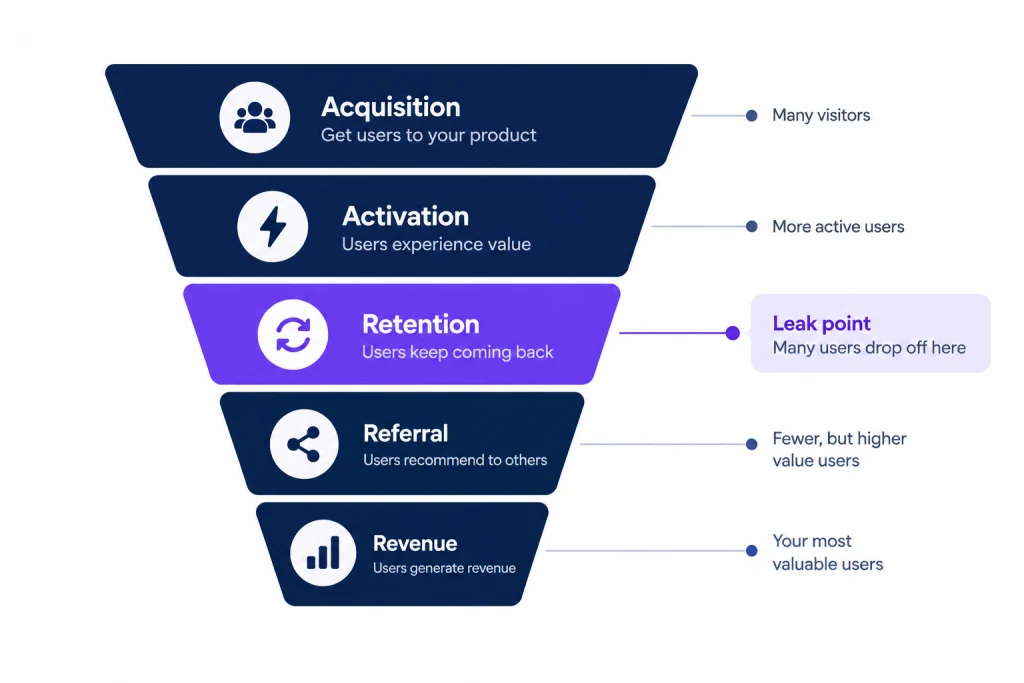
The most widely used framework in growth marketing is AARRR, nicknamed “Pirate Metrics” for how the acronym sounds out loud. It was introduced by investor Dave McClure in a 2007 talk aimed at startups drowning in vanity metrics, and it breaks the customer lifecycle into five stages:
- Acquisition: how people find you in the first place.
- Activation: whether they take the action that shows they’ve found real value (a first login, a completed setup, a first purchase).
- Retention: whether they come back and keep engaging.
- Referral: whether they like the product enough to tell others.
- Revenue: whether they’re willing to pay for it.
The point of the framework is to stop teams from optimising a single stage (usually acquisition) in isolation, since a leak anywhere else in the funnel can quietly undo all of that acquisition work.
Growth marketing vs performance marketing
These two get used almost interchangeably, but they’re not the same thing. Performance marketing, covered in our guide to performance marketing, is specifically about paid, trackable channels, paid search, social ads, affiliate, where spend is judged against measurable actions. Growth marketing is broader: it includes performance channels as one lever among several, alongside product-led tactics, retention work, and referral loops that don’t necessarily involve ad spend at all. Performance marketing is a tool growth marketers reach for, not a synonym for the whole discipline.
Core growth marketing tactics
- A/B testing: testing variations of messaging, landing pages, or onboarding flows against each other rather than guessing which performs better.
- SEO and content: compounding, low-cost acquisition that keeps working long after a single paid campaign ends.
- Paid channels: search, social, and affiliate spend used to test and scale what’s already been validated to work.
- Onboarding and activation optimisation: making sure new users actually reach the moment where the product proves its value, rather than dropping off before they get there.
- Referral and retention loops: turning existing customers into a acquisition channel, and keeping them engaged long enough to become one.
How to get started with growth marketing
- Map your funnel against the AARRR stages and identify where the biggest drop-off actually is, not where you assume it is.
- Pick one stage to focus experiments on first, rather than trying to optimise the whole funnel simultaneously.
- Run small, fast tests with a clear hypothesis and a defined success metric before scaling anything.
- Feed what you learn back into the next round of tests. Growth marketing works because it’s iterative, not because any single test is a silver bullet.
Common mistakes
- Treating growth marketing as a synonym for “more acquisition spend” rather than a whole-funnel discipline.
- Running tests without a large enough sample to draw a real conclusion, then acting on noise.
- Optimising acquisition while ignoring a leaky activation or retention stage that’s quietly wasting all of that acquisition spend.
- Never revisiting paid channel data once a campaign is live, the same problem that shows up in paid search specifically, covered in our Google Ads audit checklist.
Where paid search fits into a growth marketing strategy
Paid search is usually one of the fastest ways to test acquisition hypotheses, since it captures existing demand rather than requiring you to create it. But it only stays a good growth lever if it’s actively managed: reviewed, tested, and cleaned up as data comes in, rather than launched once and left alone. Tools like Optimyzee handle that ongoing review layer for the Google Ads side specifically, scanning search terms for waste and surfacing optimisation opportunities, so paid search stays a lever worth pulling rather than a cost centre that quietly drifts.
FAQ
Is growth marketing the same as growth hacking?
They overlap heavily. Growth hacking is generally used for the scrappier, resource-constrained version of the same idea, often associated with early-stage startups. Growth marketing is the broader, more established term for the same experimentation-driven approach.
Do I need a big budget to do growth marketing?
No, the core of growth marketing is experimentation and data, not spend. Many effective growth tactics (SEO, referral programmes, onboarding improvements) cost little beyond time.
What’s the difference between growth marketing and digital marketing?
Digital marketing describes the channels (search, social, email, and so on). Growth marketing describes an approach, testing and iterating across the full customer journey, that can be applied through any of those channels.
Which metric matters most in the AARRR framework?
None of them in isolation. The framework’s value is in showing where the funnel is leaking, so the “most important” stage is whichever one is currently losing you the most people or revenue, which is different for every business.