Quick answer: PPC management is the ongoing process of planning, launching, and optimising pay-per-click advertising campaigns, most commonly on Google Ads. It covers keyword research, bid and budget control, ad copy, Quality Score, negative keywords, landing page alignment, and conversion tracking. You can handle it in-house, hire an agency, or use software that automates the repetitive parts, and most growing accounts end up using some mix of the three.
What is PPC management?
PPC management is the day-to-day and week-to-week work of running a pay-per-click account so that it keeps performing rather than drifting. Launching a campaign is a single task. Managing it is a recurring one: checking search terms, adjusting bids, testing ad copy, pausing what underperforms, and scaling what works.
For most businesses, “PPC management” means managing Google Ads specifically, since it carries the largest share of search ad spend, though the same principles apply to Microsoft Advertising and other paid search platforms.
What does a PPC manager actually do?
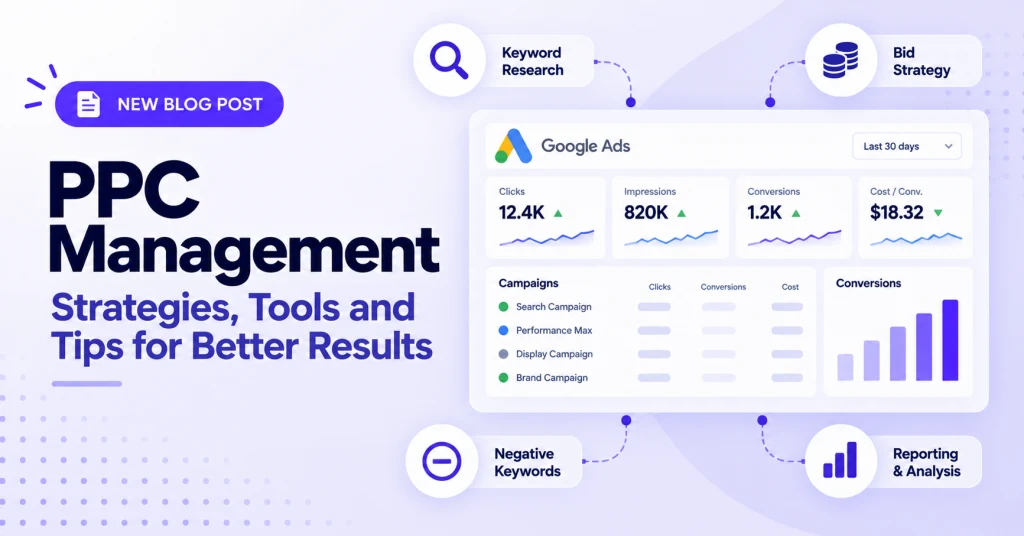
The daily and weekly tasks tend to fall into a few recurring buckets:
- Search term review: checking which actual queries triggered your ads and adding irrelevant ones as negative keywords.
- Bid and budget adjustments: reallocating spend towards keywords, ad groups, or campaigns that convert, and away from ones that don’t.
- Ad testing: writing and rotating new headlines and descriptions, particularly for Responsive Search Ads, to improve click-through rate.
- Quality Score monitoring: watching expected CTR, ad relevance, and landing page experience for signs a keyword or ad group needs attention.
- Reporting: tracking cost per conversion, ROAS, and spend pacing against the budget, and explaining what changed and why.
None of this is a one-off setup task. An account that’s set up well in January and never touched again will usually perform worse by June, simply because search behaviour, competition, and costs all shift over time.
In-house, agency, or software: who should manage your PPC?
There’s no single right answer here, it depends on account size, budget, and how much time you have.
- In-house: makes sense when you have the time to learn the platform properly and want full control, particularly for smaller accounts where an agency retainer wouldn’t be cost-effective.
- Agency: useful when you’re managing multiple accounts, need specialist strategy work, or don’t have the internal bandwidth. Multi-account management brings its own workflow challenges, covered in our guide to managing multiple Google Ads accounts.
- Software: increasingly used alongside either option to handle the repetitive, data-heavy parts, like scanning search terms for waste or drafting negative keyword recommendations, freeing up time for strategy instead of manual review.
Most accounts beyond a certain size end up using some combination: a person or agency setting direction, with software handling the ongoing monitoring that would otherwise eat hours every week.
The core components of PPC management
Keyword research and match types
Good PPC management starts with keywords that match what people actually search, not just what you assume they search. Match type choice (broad, phrase, or exact) determines how tightly your ads are targeted, and gets revisited constantly as search term data comes in.
Quality Score and Ad Rank
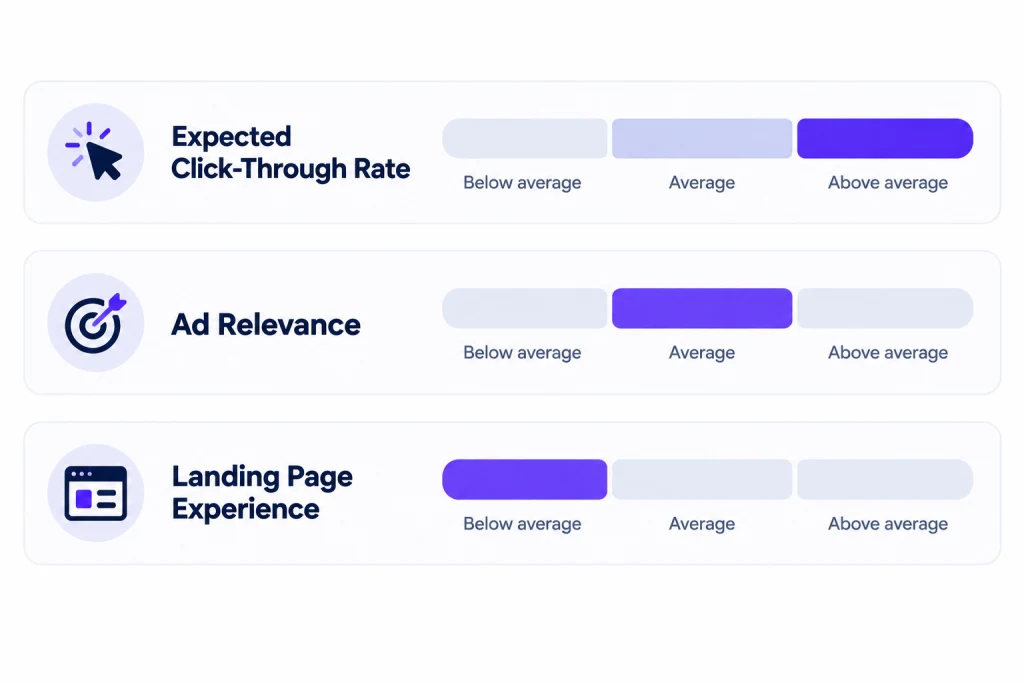
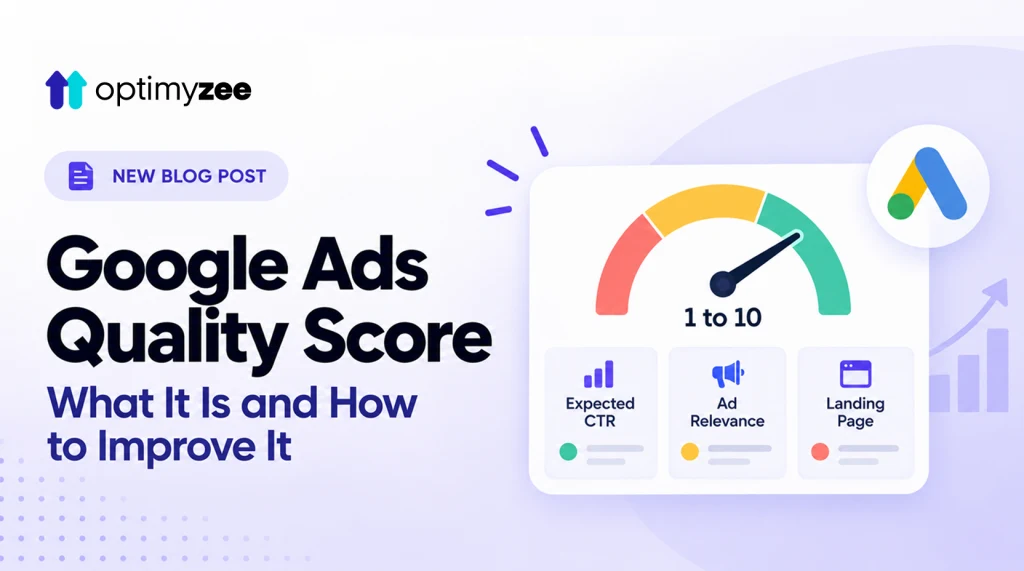
Quality Score is Google’s own estimate of how relevant your ads, keywords, and landing pages are, scored from 1 to 10 based on expected click-through rate, ad relevance, and landing page experience. It isn’t a direct input into the ad auction itself, but it’s a useful diagnostic: a low score on any one of those three factors usually points to exactly where an ad group needs work.
Negative keywords
Negative keywords stop your ads from showing for searches that will never convert. A search ads account without an actively maintained negative keyword list will keep bleeding budget on irrelevant clicks, jobs, freebies, unrelated products, no matter how well the core keywords are chosen. Our guide to reducing PPC costs covers this in more depth.
Ad copy and creative testing
Responsive Search Ads let Google test combinations of headlines and descriptions automatically, but the inputs still need to be written and refreshed by a human (or AI-assisted) process. Stale ad copy is one of the most common reasons accounts plateau.
Landing page experience
The best keyword and ad combination still underperforms if the landing page doesn’t match what was promised. Landing page relevance is one of the three official components of Quality Score, and it’s also the piece most PPC managers have the least direct control over, since it usually depends on someone else’s website changes.
Conversion tracking and reporting
None of the above can be optimised without accurate conversion data. Broken or missing conversion tracking is one of the most common, and most damaging, PPC management problems, since every other decision downstream depends on it being right.
Common PPC management mistakes
A few mistakes show up repeatedly across accounts, regardless of size or industry, covered in more detail in our guide to Google Ads mistakes to avoid:
- Setting up a campaign once and never revisiting the search terms report.
- Chasing Quality Score as a number rather than fixing the underlying CTR, relevance, or landing page issue it’s flagging.
- Letting budget concentrate on broad match keywords without a negative keyword list to keep it in check.
- Making bid or budget changes based on a few days of data instead of a statistically meaningful sample.
How much does PPC management cost?
Costs vary widely depending on the route you choose. In-house management is mostly a time cost rather than a cash one. Agencies typically charge either a flat retainer or a percentage of ad spend, on top of the ad spend itself. Software sits at the lower end of the cost spectrum and is usually priced to handle the repetitive monitoring work rather than replace strategic decision-making entirely.
How AI is changing PPC management
The most time-consuming parts of PPC management, search term review, negative keyword discovery, RSA drafting, are also the most repetitive, which makes them well-suited to automation. Tools like Optimyzee are built specifically to handle that layer: scanning search terms for wasted spend, surfacing negative keyword recommendations for review, and drafting RSA and asset variations, so the time freed up goes towards strategy rather than manual audits.
FAQ
Is PPC management the same as SEO?
No. PPC management covers paid search advertising, where you pay per click for placement. SEO is about earning organic (unpaid) rankings. The two are complementary but require different skills and are usually measured separately.
How often should a PPC account be checked?
Search term and spend reviews are commonly done weekly, with deeper strategic reviews monthly. Newer or higher-spend accounts often need more frequent attention until performance stabilises.
Can I manage PPC myself without an agency?
Yes, particularly for smaller accounts. The main trade-off is time: doing it properly means regularly reviewing search terms, testing ad copy, and tracking conversions, not just launching a campaign and leaving it.
What’s the difference between PPC management and a PPC audit?
A PPC audit is a one-time (or periodic) deep review of an account’s current state and problems. PPC management is the ongoing, continuous work of running the account day to day. Our Google Ads audit checklist covers what a thorough audit should include.
Sources
- Google Ads Help: About ad quality
- Google Ads Help: Quality Score: What it is and how it’s calculated
- Google Ads Help: About negative keywords