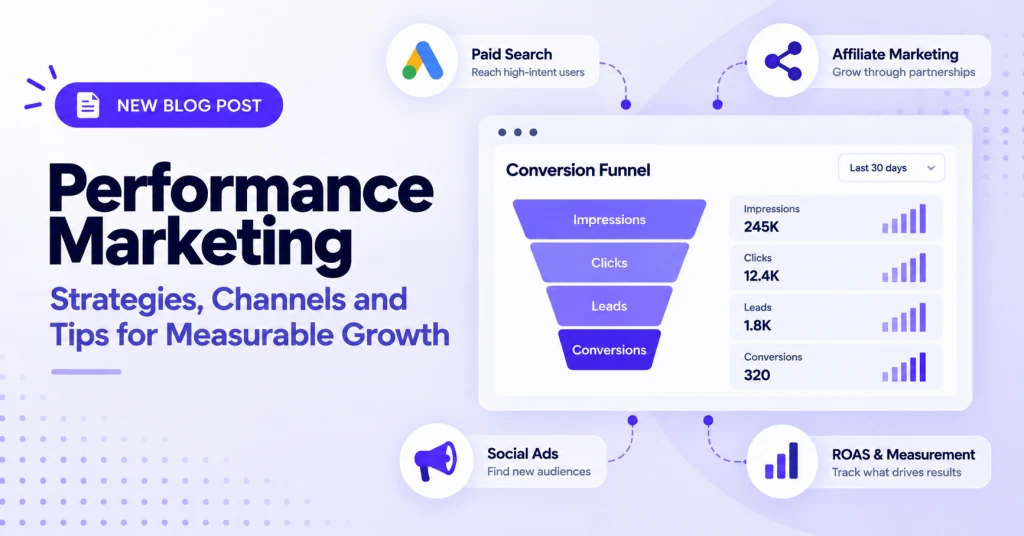
Quick answer: Performance marketing is a form of digital marketing where spend is tied directly to measurable actions, clicks, leads, or sales, rather than to impressions or exposure alone. It spans channels like paid search, affiliate marketing, social advertising, and native ads, and it’s judged by tracked outcomes (CPA, CPL, CPS, ROAS) rather than reach or brand recall. It sits at the opposite end of the spectrum from traditional brand advertising, which pays for visibility regardless of whether anyone acts on it.
What is performance marketing?
According to the Interactive Advertising Bureau (IAB), a genuine performance marketing campaign meets a specific set of criteria: the intention is to drive a consumer action rather than raise awareness, the link between the advertising and that action can be clearly measured, and the buyer can optimise the campaign in real time (or close to it) based on that measurement.
In practice, that means every dollar spent is expected to be traceable to an outcome. If you can’t measure whether an ad led to a click, a lead, or a sale, it isn’t really performance marketing, it’s brand advertising wearing a performance label.
Performance marketing vs brand marketing
The two sit at opposite ends of the same spectrum, and most companies need both, just for different jobs:
- Brand marketing pays for exposure and reach, TV spots, sponsorships, display impressions, regardless of whether the viewer acts immediately. Its payoff is long-term recall and trust.
- Performance marketing pays for (or is judged against) a specific, trackable action. Its payoff is immediate and measurable, but it depends on demand already existing somewhere for it to capture.
This is also why performance marketing tends to work best as a lower-funnel strategy: it’s built to convert demand that already exists, rather than to create demand from scratch.
The core channels
Performance marketing isn’t one channel, it’s an approach applied across several:
- Search engine marketing (SEM) / PPC: paid search ads on Google, Bing, and similar platforms, priced and judged by clicks and conversions.
- Affiliate marketing: publishers promote a product and earn a commission only when a defined action (usually a sale) happens.
- Social media advertising: paid placements on platforms like Meta, TikTok, and LinkedIn, priced by engagement, clicks, or conversions rather than flat sponsorship fees.
- Native and programmatic advertising: ads that blend into the platform’s content, bought and optimised through real-time bidding.
Paid search sits at the centre of most performance marketing budgets, since it captures existing demand (someone actively searching) rather than interrupting attention, which is part of why it’s judged so heavily on efficiency metrics like cost per click and cost per conversion.
How performance marketing is measured
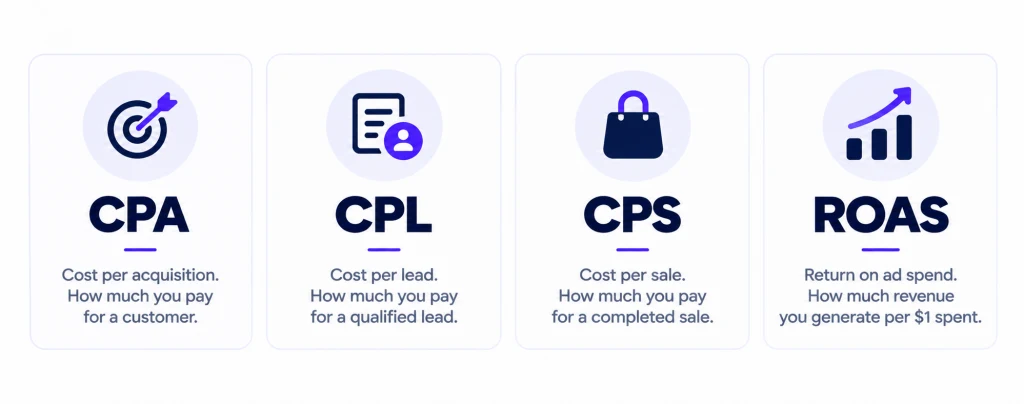
Because the whole model depends on tracking, the vocabulary is built around payment and pricing tied to action:
- CPA (Cost Per Acquisition): cost for each completed conversion, sale, signup, or lead.
- CPL (Cost Per Lead): cost for each qualified lead generated.
- CPS (Cost Per Sale): cost tied specifically to a completed sale, common in affiliate marketing.
- ROAS (Return On Ad Spend): revenue generated per unit of ad spend, the headline number most performance teams report against.
None of these numbers mean much without accurate conversion tracking sitting underneath them. Broken or incomplete tracking is one of the most common reasons performance marketing budgets get misallocated, since every optimisation decision downstream assumes the data is right.
Performance marketing vs growth marketing
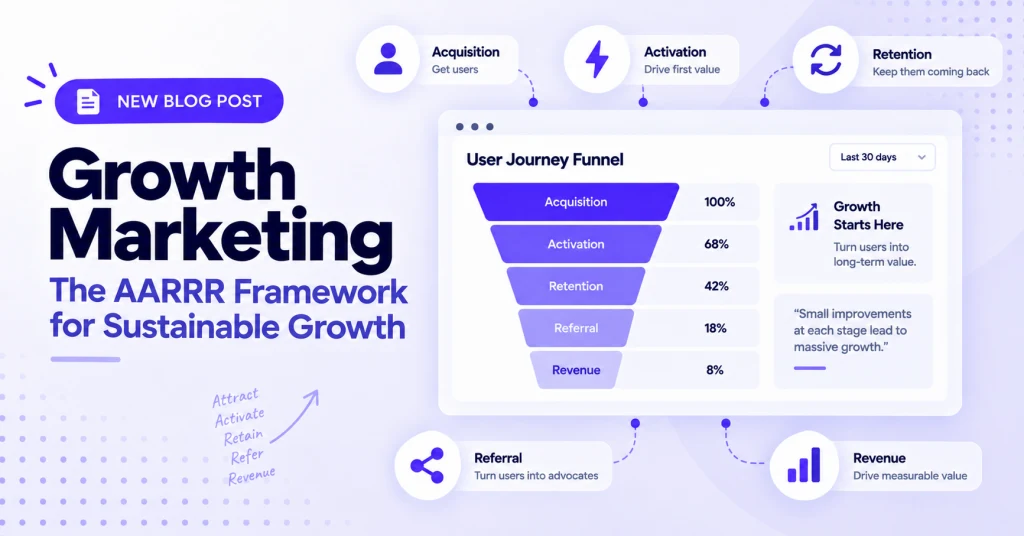
The two terms get used almost interchangeably, but there’s a useful distinction. Performance marketing is about efficiently converting demand that already exists through paid, trackable channels. Growth marketing is broader: it includes performance channels, but also product-led tactics, experimentation, retention, and referral loops that don’t necessarily involve ad spend at all. Performance marketing is a tool growth marketers use, not a synonym for the whole discipline.
Common challenges
- Attribution: customers rarely convert from a single touchpoint, so assigning credit accurately across channels is an ongoing problem, not a one-time setup.
- Rising costs: CPCs and CPMs across most performance channels have trended upward for years as competition for the same auctions increases.
- Privacy and tracking changes: browser and platform-level privacy changes have made the “measure everything precisely” promise of performance marketing harder to deliver than it was a few years ago.
- Wasted spend hiding in the data: even well-tracked campaigns bleed budget on low-intent clicks and irrelevant search terms if nobody’s actively reviewing the data. Our guide to reducing PPC costs covers this specifically for paid search.
How AI is changing performance marketing
The channels haven’t changed much, but the amount of manual review needed to run them well has dropped sharply. Automated bidding strategies now handle bid-level optimisation that used to be manual guesswork, and tools are increasingly able to scan performance data for waste and surface fixes rather than requiring someone to dig through spreadsheets. Optimyzee applies this specifically to the paid search side of performance marketing, scanning search terms for wasted spend and surfacing negative keyword and RSA recommendations, so the review work that used to eat hours gets compressed into minutes.
FAQ
Is performance marketing the same as digital marketing?
No. Digital marketing is the umbrella term for all online marketing activity, including brand-building work like organic social content or SEO. Performance marketing is the subset of digital marketing specifically tied to measurable, trackable actions.
What’s the difference between performance marketing and PPC?
PPC (pay-per-click, mainly search advertising) is one channel within performance marketing. Performance marketing is the broader strategy; PPC, affiliate marketing, and paid social are all channels used to execute it.
How is performance marketing measured?
Through action-based metrics like cost per acquisition (CPA), cost per lead (CPL), cost per sale (CPS), and return on ad spend (ROAS), rather than impressions or reach alone.
Is performance marketing good for brand awareness?
Not primarily. It’s built to convert existing demand efficiently, not to build recall or awareness from scratch. Most companies run brand marketing and performance marketing side by side for that reason, each doing a different job.