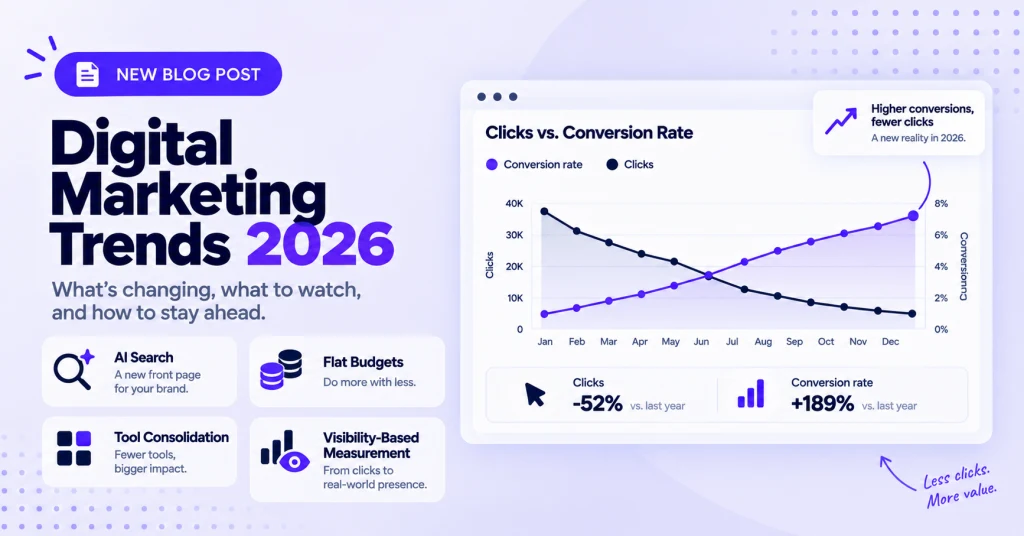
Quick answer: Four digital marketing trends have genuinely proven themselves by mid-2026, rather than just staying on conference slides: search behaviour migrating into AI engines and zero-click experiences, AI moving from pilot projects into real marketing operations, flat budgets forcing consolidation onto fewer tools, and measurement being rebuilt around visibility rather than clicks alone. Short-form video, first-party data, and agentic AI remain important but are earlier-stage and worth watching rather than fully proven yet.
The trends that have actually materialised
Search is migrating into AI engines
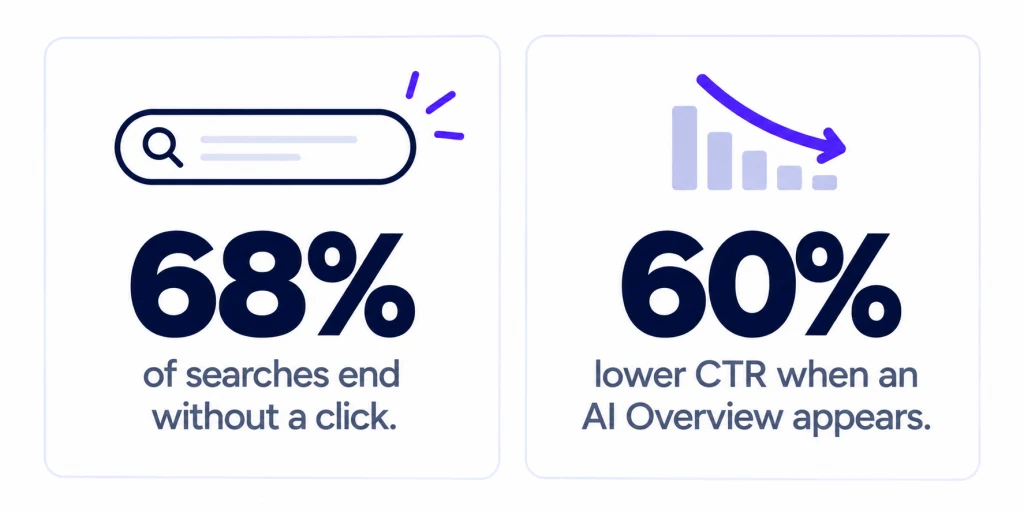
This is the trend with the hardest data behind it. Roughly 68% of Google searches now end without a click, and click-through drops by around 60% when an AI Overview appears on the results page. Being visible inside AI-generated answers, not just ranking for a query, has become its own discipline, separate from traditional SEO or SEM. We cover what this specifically means for paid search in our guide to ads in Google AI Overviews.
AI is moving from pilots to actual operations
Every marketing team has been experimenting with AI for a while now. What’s new in 2026 is the shift from isolated pilots to AI genuinely embedded in day-to-day operations, bidding, reporting, content drafting. CMOs are putting roughly 15.3% of budget into AI, but only about 30% say their organisation is actually ready to scale it. The gap isn’t the technology, it’s operational readiness.
Flat budgets are forcing consolidation
Marketing budgets have held roughly flat at 7.8% of company revenue, and martech’s share of that budget has hit a five-year low. Rather than adding more point solutions, teams are consolidating onto fewer platforms that can do more, which is part of why AI-native, multi-function tools are gaining ground over single-purpose ones.
Measurement is shifting from clicks to visibility
With overall click volume falling, the visitors who do arrive, particularly from AI-generated answers, tend to be later in their research and convert at meaningfully higher rates. A smaller stream of traffic that converts better changes how teams need to think about attribution and reporting, not just raw click and impression counts.
Trends worth watching, but not yet fully proven
- Agentic AI: autonomous systems that can execute multi-step campaign workflows with less manual oversight, still early, but the direction is clear.
- First-party data as the default: third-party cookie deprecation and newer privacy regulation are pushing owned audience data from a nice-to-have to a requirement.
- Short-form video: continues to dominate social strategy, though its role in a paid-search-first strategy remains supplementary rather than central.
What this means for paid search specifically
The zero-click and AI Overview trend is the one that matters most directly for Google Ads. As organic clicks compress, the accuracy of your conversion tracking and the efficiency of your paid spend both matter more, not less, since a smaller volume of higher-intent clicks leaves less room for waste to hide unnoticed. This is also why performance marketing’s shift toward being fully data-driven, covered in our guide to performance marketing, and accurate conversion tracking specifically, matter more this year than in previous ones.
How to adapt your strategy
- Audit how much of your current traffic and conversions come from AI-influenced search behaviour, not just traditional organic and paid clicks.
- Tighten conversion tracking before increasing spend, a smaller, higher-intent traffic stream punishes bad tracking harder than a large, noisy one did.
- Consolidate tooling where it makes sense rather than adding another point solution to a flat budget.
- Treat AI adoption as an operational project, not a pilot, the gap between experimenting with AI and actually running on it is where most teams are currently stuck.
FAQ
Are AI Overviews actually reducing clicks to websites?
Yes, the data shows a meaningful drop, roughly 60% lower click-through when an AI Overview appears for a given search, alongside a broader rise in zero-click searches overall.
Should I reduce my Google Ads spend because of AI search changes?
Not necessarily. The traffic that does still click tends to convert better, so the priority is tightening measurement and targeting rather than pulling back spend outright.
Is short-form video worth investing in for a B2B or SaaS brand?
It depends on your audience. It remains a strong trend for consumer brands, but for B2B and SaaS specifically, it’s usually a secondary channel rather than a primary strategy.
What’s the single biggest change marketers need to prepare for in 2026?
The shift from clicks to visibility as the core measurement question, since it affects both how you report on paid search performance and how you judge whether content and SEO work is actually landing.