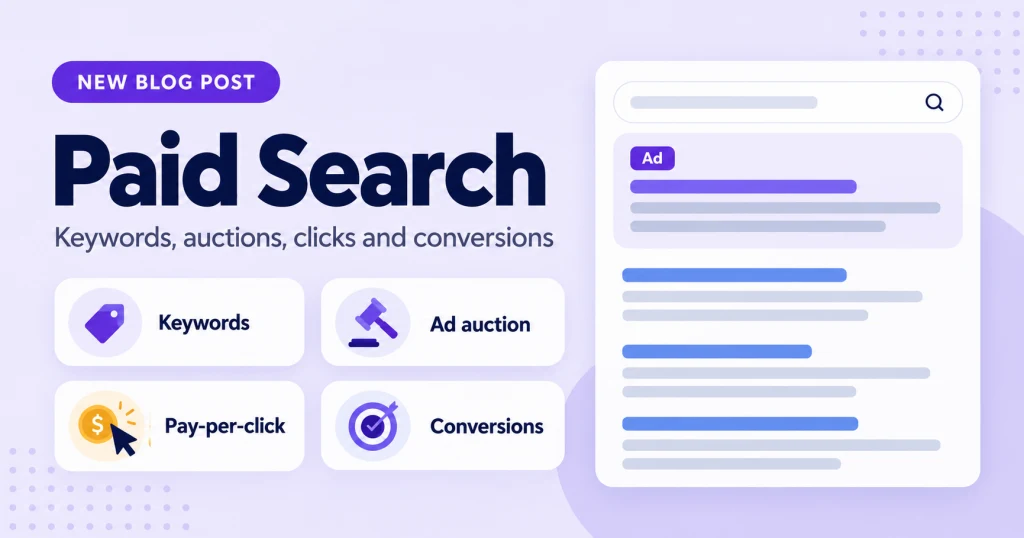
Quick answer: Paid search is a form of online advertising where you bid to show ads on search engine results pages, usually paying each time someone clicks (pay-per-click, or PPC). Your ad appears when someone searches for a term you’ve targeted. Google Ads is the biggest platform, with Microsoft Advertising as the main alternative. Whether and where your ad shows depends on your bid, the quality of your ad and landing page, and how competitive the search is, not on budget alone.
What is paid search?
Paid search means paying to have your ad shown when someone types a query into a search engine. Unlike most advertising, it reaches people at the moment they’re actively looking for something, which is why it’s usually treated as a way to capture existing demand rather than create it.
You’ll often see it called search engine marketing (SEM) or PPC. The terms overlap: PPC describes how you’re charged (per click), paid search describes where the ads appear (search results), and SEM sometimes covers both paid and organic search work. In practice most people use them interchangeably for the paid side. If you want the day-to-day side of running campaigns, see our guide to PPC management.
How paid search works
The process is the same on most platforms:
- You choose keywords that describe what your customers search for.
- You write ads and point them at a landing page.
- You set a bid and a budget. The bid is the most you’re willing to pay for a click, and you often pay less than that maximum.
- An auction runs every time someone searches. The platform decides in a split second whether your ad is eligible and where it should appear.
- You pay when someone clicks, and track what they do next with conversion tracking.
How the paid search auction works
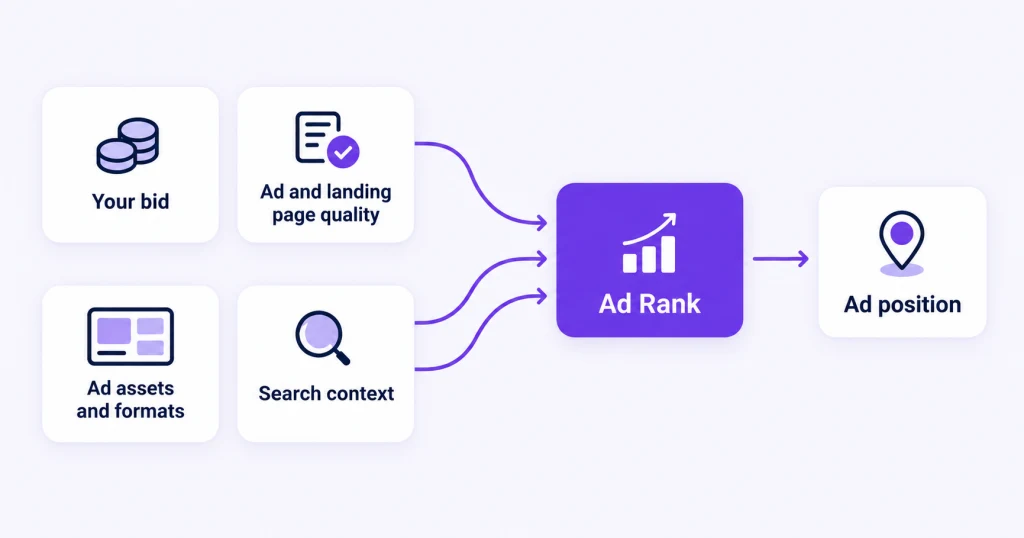
Google Ads runs a separate auction each time someone searches. What decides whether your ad shows, and where, is a score called Ad Rank. According to Google, it depends on several things:
- Your bid: the most you’re willing to pay per click.
- Ad and landing page quality: how useful and relevant your ad and landing page are to the searcher, summarised in Quality Score.
- Minimum thresholds: ads must reach a minimum quality level to appear in a given position.
- Expected impact of ad assets and formats: extras like sitelinks or phone numbers that are estimated to improve performance.
- Search context: the search terms, location, device, and time of search.
The practical takeaway: the highest bidder doesn’t automatically win. A relevant ad with a good landing page can outrank a higher bid, and higher-quality ads often cost less per click. Our guides to how Google Ads auctions work and Quality Score go deeper on both.
Paid search vs organic search
Both appear on the same results page, but they work very differently:
- Speed: paid search can bring traffic within days of launching. Organic rankings usually take months to build.
- Cost: paid search charges per click, and traffic stops when the budget does. Organic traffic doesn’t charge per click, but it costs time and content work to earn.
- Control: with paid search you choose the message, the keywords, and the landing page. Organic rankings are decided by the search engine.
- Durability: a ranking page can keep bringing visitors for years. Paid traffic ends when you stop paying.
Most businesses use both. Paid search gets you in front of buyers now, and organic builds a lower-cost source of traffic over time. The same split is often described as SEM vs SEO or PPC vs SEO.
The main paid search platforms
- Google Ads: the largest search platform, with campaign types from standard Search to Performance Max. Start with our guide to setting up a search campaign.
- Microsoft Advertising: reaches Bing and its partner network, often at lower competition than Google.
When paid search makes sense
- You sell something people already search for by name or by need.
- You need leads or sales soon and can’t wait months for rankings.
- You want to test messaging or a new offer quickly.
- You can track conversions, so you know what each click is worth.
It’s a weaker fit when nobody is searching for what you offer yet. In that case you’re creating demand rather than capturing it, and channels like content, social, or events usually do that job better. Paid search also sits inside the wider performance marketing toolkit, alongside affiliate and paid social.
Common paid search mistakes
- No conversion tracking. Without it you’re optimising for clicks, not results. See our guide to Google Ads conversion tracking.
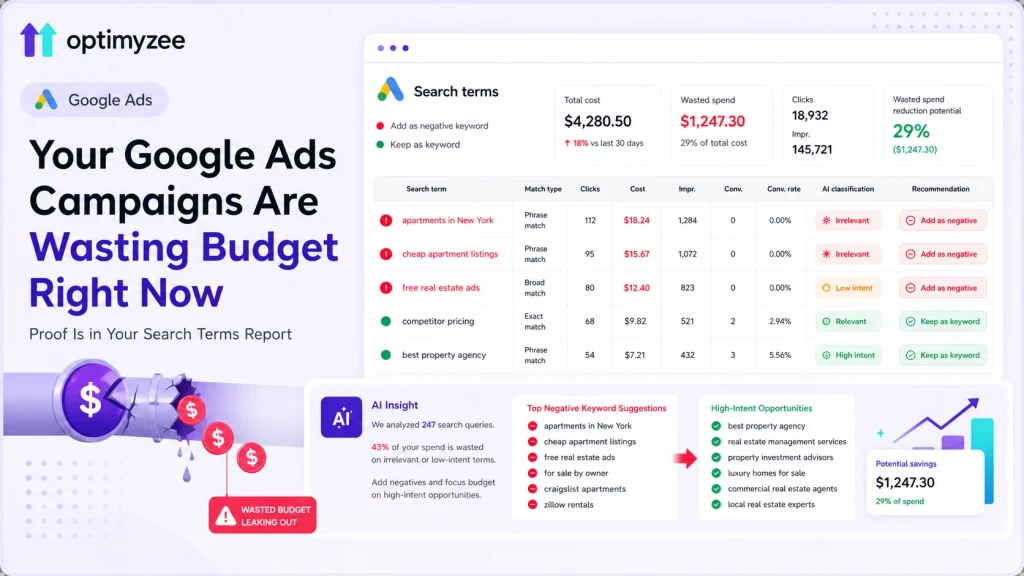
- Ignoring search terms. Broad targeting can match irrelevant searches. Reviewing search terms and adding negative keywords stops that spend.
- Sending all clicks to the homepage. A landing page that matches the ad usually converts better and improves quality.
- Judging results too early. Decisions based on a few days of data are often noise.
FAQ
What is paid search?
Paid search is advertising on search engine results pages where you bid on keywords and typically pay each time someone clicks your ad.
Is paid search the same as PPC?
Almost. PPC refers to the pay-per-click pricing model, and paid search refers to ads on search results. In everyday use, the two terms usually mean the same thing.
How much does paid search cost?
It depends on your keywords, industry, and competition. You set your own budget and maximum bids, and the cost per click varies by search. There is no minimum fixed price set by the platform.
Is paid search better than SEO?
Neither is better in general. Paid search is faster and easier to control, while SEO is slower but builds lasting traffic. Most businesses benefit from combining them.
Does paying for ads improve organic rankings?
No. Running ads doesn’t change where your pages rank in organic results. The two are measured and managed separately.
Sources
- Google Ads Help: How the Google Ads auction works
- Google Ads Help: About Ad Rank