Quick answer: SaaS marketing is the practice of acquiring, activating, and retaining customers for a subscription software product. Because customers pay month after month, the job doesn’t end at the first sale: it covers sign-ups, getting users to their first real result, keeping them, and growing the account. The main channels are SEO and content, product-led growth, outbound, paid search, partnerships, and community, and success is measured with metrics like CAC, LTV, CAC payback period, and churn.
What is SaaS marketing?
SaaS (software as a service) marketing promotes software that customers rent through a subscription rather than buy once. That changes what marketing is responsible for. A one-off purchase can be judged on the sale. A subscription is judged on whether the customer stays and expands, so marketing is tied to the whole lifecycle: acquisition, activation, retention, and expansion.
It also means marketing and product need to share definitions. For example, what counts as an “activated” user should be agreed between both teams, and it should be a real value event, not just completing a tutorial.
The SaaS marketing funnel
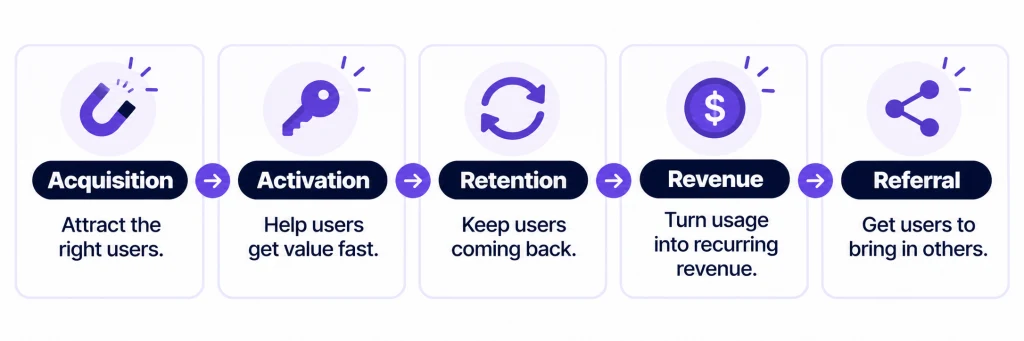
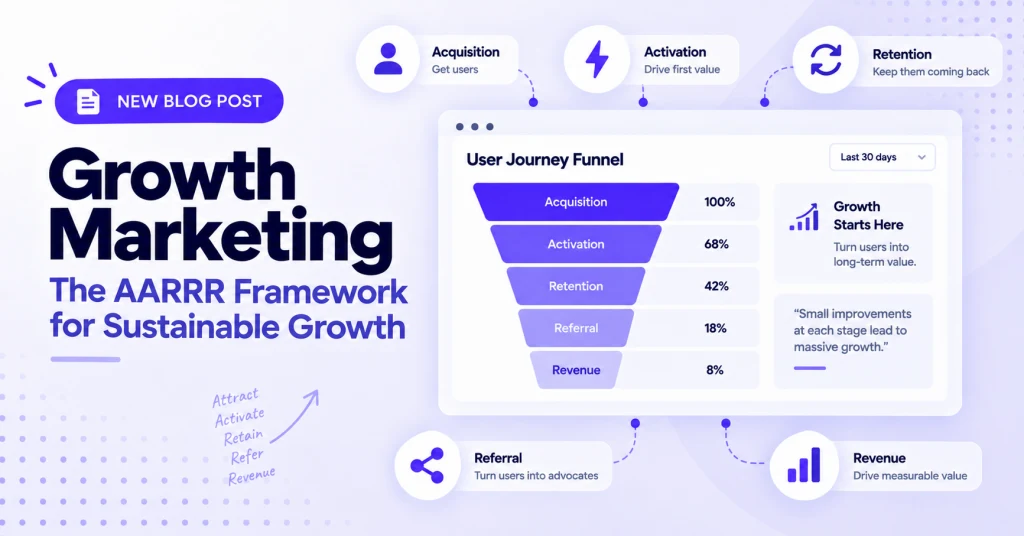
A common way to map the lifecycle is the AARRR model, sometimes called pirate metrics:
- Acquisition: how people find you.
- Activation: whether new sign-ups reach the product’s core value.
- Retention: whether they keep using and paying.
- Revenue: how they convert and expand into paying accounts.
- Referral: whether they bring others in.
For more on how this model fits into the wider discipline, see our guide to growth marketing.
Main SaaS marketing channels
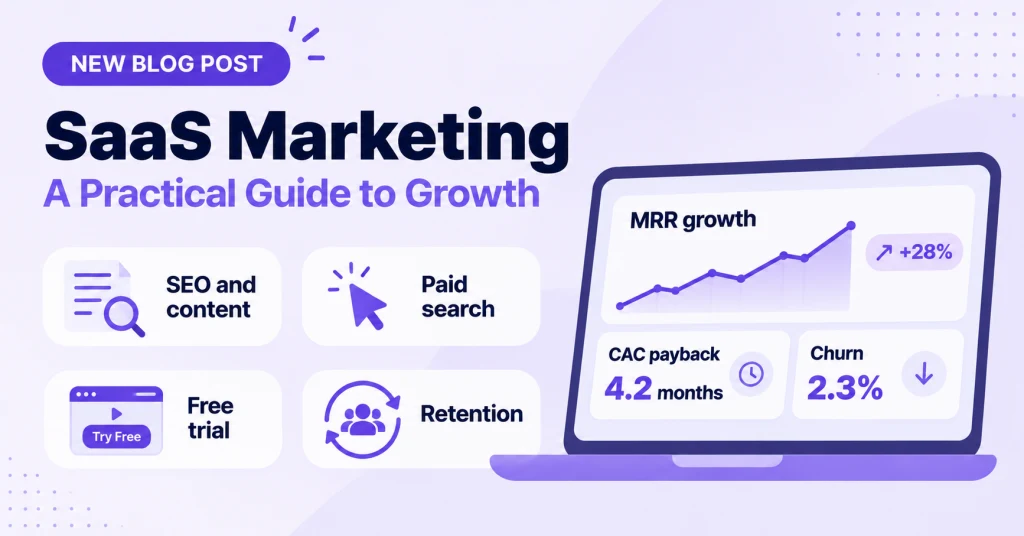
- SEO and content marketing: builds traffic that keeps compounding, and suits buyers who research before they buy.
- Product-led growth and self-serve: the product itself, through a free trial or freemium plan, brings in and converts users.
- Outbound SDR and email: direct outreach to target accounts, more common for higher-priced products.
- Paid search: captures buyers who are actively searching for a solution. See our guide to paid search.
- Partner and marketplace channels: reach audiences through integrations and other platforms.
- Community: builds trust and word of mouth through forums, groups, and events.
No channel wins everywhere. The right mix depends on whether buyers evaluate the product themselves or need sales help, and each channel should be judged against the same cost and outcome measures.
Free trial or freemium?
This is one of the first decisions for a self-serve product. A few questions help decide:
- Can users reach real value quickly?
- What will make them willing to pay?
- What does supporting free users cost you?
- What happens to their data when access ends?
The SaaS marketing metrics that matter
- CAC (customer acquisition cost): total sales and marketing spend divided by new customers. Track a blended figure and a paid-only figure separately.
- LTV (lifetime value): the revenue a customer is expected to generate. It’s a projection, so it depends on your margin and churn assumptions.
- LTV:CAC ratio: lifetime value relative to acquisition cost. A ratio of about 3:1 is a commonly used rule of thumb, though it’s a convention rather than a universal standard.
- CAC payback period: how many months it takes to earn back what you spent to win a customer, using gross margin rather than revenue.
- MRR and ARR: monthly and annual recurring revenue.
- Churn: customers or revenue lost over time.
- Net revenue retention (NRR): revenue kept from your existing customers, including expansion. Above 100% means the base grows even without new customers.
- Activation rate and time to first value: how many sign-ups reach your core value moment, and how fast.
How to calculate CAC payback
A standard company-level formula is:
Payback (months) = (Sales and marketing spend ÷ New ARR × Gross margin) × 12
As an example, $600,000 of sales and marketing spend, $500,000 of new ARR, and a 75% gross margin gives about 19 months. For benchmarks, the 2026 Aleph × Benchmarkit report puts the median B2B SaaS CAC payback at 16 months, with the top quartile at 6 months or less and the bottom quartile at 24 months or more. Payback also varies by deal size: the same report shows a median of 11 months for products under $5K ACV and 22 months for $50K to $100K ACV.
Look at payback by channel, not just in total. A blended figure can hide a weak paid channel when organic and referral customers pull the average down. Reading it by channel means you can move budget where payback is shortest. If paid search is one of your channels, cutting wasted spend directly shortens its payback, and our guide to finding wasted budget in search terms shows where to look.
A simple SaaS marketing strategy
- Choose a growth model: product-led, sales-led, or a mix, based on how your buyers evaluate software.
- Build content around your ideal customer’s questions, grouping related topics together and avoiding near-duplicate pages.
- Set a budget from work you can actually deliver, and count each cost once.
- Agree on metric definitions across marketing, product, and finance.
- Review by channel and cohort, so you compare like with like over a clear time window.
Common SaaS marketing mistakes
- Focusing only on sign-ups. Sign-ups that never activate cost money and add no revenue.
- Using revenue instead of margin for payback. That makes every channel look better than it is.
- Relying on one blended number. It hides which channels are working.
- Ignoring retention. Churn quietly cancels out acquisition.
FAQ
What is SaaS marketing?
SaaS marketing is the set of activities used to attract, convert, and retain customers for subscription software, covering the full lifecycle rather than just the first sale.
How is SaaS marketing different from regular marketing?
The main difference is the subscription model. Revenue comes over time, so marketing is judged on retention and expansion as well as acquisition, and payback is measured against gross margin rather than the first payment.
What are the best SaaS marketing channels?
There’s no single best channel. SEO and content, product-led growth, paid search, outbound, partnerships, and community all work in different situations. The right mix depends on your product, price, and how buyers evaluate software.
What is a good CAC payback period?
Per the 2026 Aleph × Benchmarkit report, the median for B2B SaaS is 16 months. Top-quartile companies recover their acquisition cost in 6 months or less. What’s acceptable also depends on deal size and segment.
What is the LTV to CAC ratio?
It compares what a customer is worth over their lifetime to what it cost to win them. A ratio of around 3:1 is often used as a rule of thumb, but it’s a convention, not a fixed standard.
Sources
- SaaS Hero: Marketing Payback Period for SaaS: Formula and Benchmarks (citing the 2026 Aleph × Benchmarkit SaaS and AI Performance Benchmarks)
- Konabayev: SaaS Marketing Strategy in 2026: The Complete B2B Playbook
- Stackmatix: SaaS Marketing Metrics: The Numbers That Drive Growth Decisions