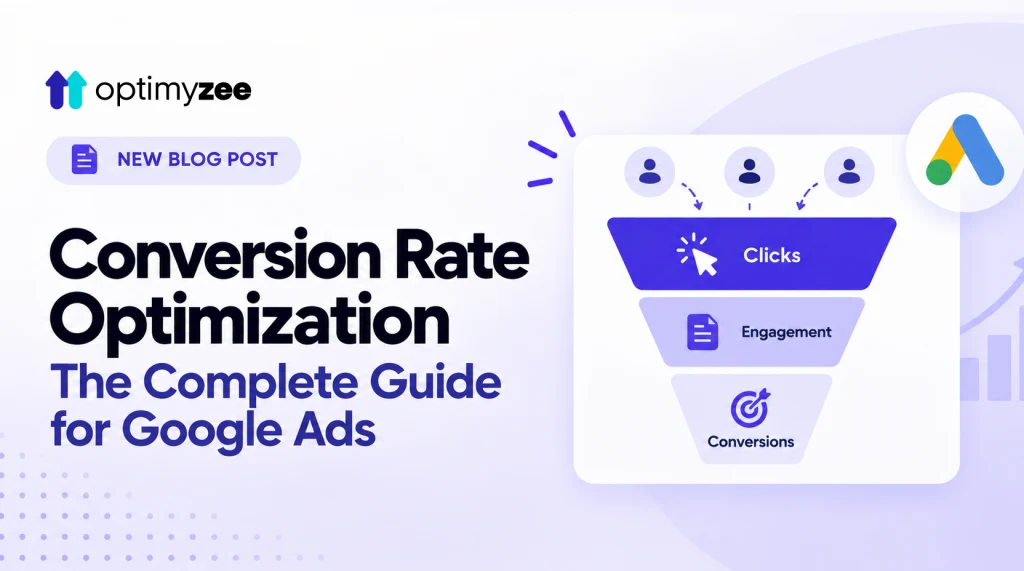
Quick Answer: Conversion rate optimization (CRO) for Google Ads means systematically improving the percentage of ad clicks that turn into completed actions, purchases, leads, sign-ups, without necessarily spending more on traffic. The average Google Ads conversion rate sits around 7.04% across all industries, according to WordStream’s benchmark data, though this varies enormously by vertical, some industries average above 15%, others under 2%. The three places conversion rate actually gets won or lost are traffic quality (are the right people clicking), landing page experience (does the page deliver on what the ad promised), and conversion tracking accuracy (are you even measuring the real number). Most accounts chasing a better conversion rate look at ad copy first. The bigger, more consistent gains usually come from the landing page and the traffic match, not the ad itself.
Most Google Ads accounts eventually hit a ceiling where more budget stops producing more results. Cost per click keeps climbing, or impression share is already near maximum, and the obvious lever, spend more, stops working. That’s the point where conversion rate optimization becomes the higher-leverage move: getting more out of the traffic you’re already paying for, instead of paying for more traffic.
This guide covers what CRO actually means in a Google Ads context specifically, what realistic benchmarks look like, where the real gains come from, and a practical framework for finding and fixing what’s actually costing you conversions.
What CRO Means for Google Ads Specifically
Conversion rate optimization is often discussed as a general website discipline, and a lot of CRO content treats every traffic source the same way. That’s a mistake in a paid search context, because Google Ads traffic has a property that organic or social traffic doesn’t: you already know exactly what the person searched for.
That’s the entire advantage. Someone who clicked your ad for “emergency plumber same day” typed that specific phrase into Google seconds before landing on your page. CRO for Google Ads is fundamentally about not wasting that signal, making sure everything downstream of the click, the landing page, the form, the offer, stays as tightly matched to that stated intent as the ad copy that got them there.
This is different from general-purpose CRO, which often has to guess at visitor intent from behavior alone. In Google Ads, the intent is already known. The optimization problem is keeping that thread unbroken all the way to conversion.
What a Good Conversion Rate Actually Looks Like
According to WordStream’s annual Google Ads benchmarks report, based on an analysis of over 17,000 campaigns, the average conversion rate across all industries is 7.04%. Other benchmark reports place the cross-industry average lower, in the 4.4% to 4.8% range, the variance largely comes down to differences in methodology and which accounts get included in each dataset.
What matters more than the headline average is the spread by industry. Some examples from recent benchmark data:
- Legal services: roughly 6-7.5%
- Healthcare: can run significantly higher, into the low-to-mid 20s in some reports
- B2B SaaS: typically 2.5-4%, with top performers reaching 5-8%
- E-commerce: generally 2-3.7%
- B2B general (longer sales cycles): often the lowest segment, sometimes under 2%
The practical takeaway: a cross-industry average is close to useless as your personal benchmark. A 2% conversion rate might be a real problem for a local service business and a perfectly healthy number for a complex B2B software sale. Compare your account against your own vertical, and ideally against your own account’s historical performance, not against a generic number pulled from a report.
Where Conversion Rate Actually Gets Won or Lost
1. Traffic quality, before anything else
If the wrong people are clicking your ads, no landing page in the world fixes that. This is where negative keywords, tight ad group themes, and match type discipline matter more than most advertisers give them credit for when they’re specifically thinking about conversion rate. A search term report full of low-intent traffic will always drag conversion rate down regardless of what happens after the click.
2. Landing page experience
This is usually the biggest lever, and the most commonly ignored one. A well-written ad sending traffic to a slow, generic, or mismatched landing page will underperform no matter how good the copy is. This same component, landing page experience, is one of the three factors behind Google Ads Quality Score, so improving it pays off in both lower CPCs and a higher conversion rate at once. The specific things that move the needle:
- Message match: the headline on the landing page should echo the promise in the ad. If the ad says “24-hour emergency service,” the landing page headline shouldn’t be a generic “Welcome to Our Company.”
- Load speed: every additional second of load time measurably increases bounce rate, especially on mobile, where the majority of Google Ads clicks now originate.
- Form friction: shorter forms convert at meaningfully higher rates than longer ones. Every field you ask for that isn’t strictly necessary is a small tax on your conversion rate.
- Mobile experience specifically: with the majority of clicks coming from mobile devices, a page that works fine on desktop but is clunky on mobile is quietly costing conversions on most of your traffic.
3. Conversion tracking accuracy
This one doesn’t improve your actual conversion rate, but it determines whether you can trust the number you’re looking at at all. If tracking is duplicating conversions, missing some, or measuring the wrong action entirely, every optimization decision built on that number is built on sand. Before investing heavily in CRO work, it’s worth confirming your conversion tracking is set up correctly, otherwise you risk optimizing toward a number that doesn’t reflect reality.
A Practical CRO Framework for Google Ads
- Audit before you touch anything. Pull conversion rate by campaign, ad group, device, and landing page. Look for the biggest gaps, not the biggest spend. A high-spend campaign converting near your account average doesn’t need urgent attention. A high-spend campaign converting well below it does.
- Form a specific hypothesis, not a vague one. “Improve the landing page” isn’t a hypothesis. “Mobile users are bouncing before the form loads because of a slow hero image” is one you can actually test.
- Test one meaningful change at a time. Landing page A/B tests need enough traffic and enough time to reach statistical significance, changing five things at once and seeing a lift tells you nothing about which change actually mattered.
- Segment before you conclude. An overall conversion rate that looks flat can hide a real story underneath, mobile might be declining while desktop improves, or one campaign might be masking a problem in another. Always check device, campaign, and landing page splits before deciding nothing’s working.
- Re-measure over a full data cycle, not a few days. Conversion rate can be noisy over short windows, especially on lower-volume campaigns. Give a real change enough time before judging it.
Common Mistakes
Optimizing ad copy first. It’s the easiest thing to change, so it’s where most advertisers start. But ad copy influences click-through rate more than conversion rate. The landing page and traffic quality almost always have more room to improve.
Chasing the wrong benchmark. Comparing your account against a generic cross-industry average, rather than your own vertical or your own historical baseline, leads to either false alarm or false confidence.
Testing too many variables at once. A redesigned landing page with a new headline, new form, new images, and new offer all launched simultaneously might improve conversion rate, but you’ll have no idea which change actually drove it, which means you can’t repeat the win elsewhere.
Ignoring device-level differences. Desktop and mobile conversion rates routinely differ by several percentage points. Optimizing as if all traffic behaves the same way misses where the real problem, or the real opportunity, actually lives.
FAQ
What’s a good conversion rate for Google Ads?
It depends heavily on industry. The cross-industry average is commonly cited around 4.4-7% depending on the benchmark source, but individual verticals range from under 2% to over 15%. Compare against your specific industry and your own account’s history rather than a single universal number.
How long should a CRO test run before I draw conclusions?
Long enough to reach statistical significance, which depends on your traffic volume and existing conversion rate. Low-volume accounts may need several weeks; high-volume accounts might reach significance faster. Judging a test after a few days almost always leads to a false conclusion either way.
Does improving conversion rate lower my CPA?
Generally, yes. If the same spend produces more conversions, cost per acquisition drops proportionally. This is part of why CRO is often a better investment than simply increasing budget once an account has hit a ceiling on efficient traffic.
Should I focus on the ad or the landing page first?
The landing page, in most cases. Ad copy affects whether someone clicks; the landing page determines whether that click turns into a conversion. Since Google Ads traffic already carries known intent from the search query, the landing page is usually where that intent gets lost or preserved.
The Bottom Line
Conversion rate optimization for Google Ads isn’t a generic marketing discipline applied to paid traffic, it’s specifically about protecting the intent signal a searcher hands you the moment they click. Traffic quality, landing page experience, and accurate tracking are the three places that signal either gets preserved or lost. Fix those, in that order of investigation, before assuming the answer is a better headline.
Sources
- WordStream: “19 Conversion Rate Optimization Statistics for 2026”
- Digital Applied: “Google Ads Benchmarks 2026: CPC, CTR, CVR by Industry”
- Foundry CRO: “Google Ads CPC, CTR & Conversion Rate Benchmarks 2026”
- First Page Sage: “Average Conversion Rate for Google Ads: 2026 Report”
- Kreativa Group: “Google Ads Conversion Rates by Industry: 2026 Guide”