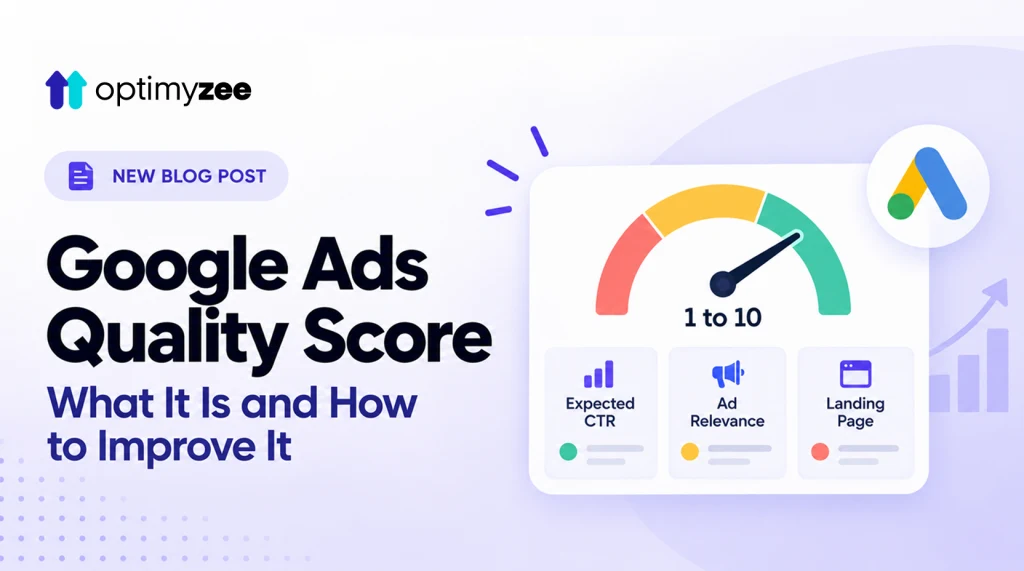
Quick Answer: Google Ads Quality Score is a 1-10 diagnostic rating, scored per keyword in Search campaigns, built from three components: expected click-through rate, ad relevance, and landing page experience. Each is rated Above average, Average, or Below average against other advertisers competing on the same search over the trailing 90 days. Google is explicit that Quality Score itself isn’t used directly in the auction, it’s a reported summary, while the real-time component evaluations feed Ad Rank, which does determine your cost per click and ad position. A higher score generally means a lower CPC for the same position, because quality sits in the denominator of how your actual cost gets calculated. Treat it as a warning light, not a target: fix the component that’s dragging a keyword down, and the number follows.
Most advertisers know Quality Score matters. Fewer can explain what it’s actually measuring, why the number on the keyword report sometimes contradicts what’s happening in the auction, or which of the three components is worth fixing first when a keyword’s underperforming.
This guide covers what Quality Score is, how it’s calculated (and what Google hasn’t published), how it connects to what you actually pay, and a practical order of operations for improving it.
What Quality Score Is, and What It Isn’t
Quality Score is a diagnostic, not a lever you pull directly. Google itself describes it as working like a warning light on a car dashboard, it tells you something needs attention, but you can’t improve the light itself, only the thing it’s pointing at.
The score is calculated from the combined performance of three components:
- Expected click-through rate (CTR): how likely your ad is to be clicked when shown, for this specific query
- Ad relevance: how closely your ad copy matches the intent behind the search
- Landing page experience: how relevant, transparent, and easy to navigate your landing page is for someone who clicks
Each component is rated Above average, Average, or Below average, compared against other advertisers whose ads showed for the exact same search over the trailing 90 days.
Two things worth being precise about, since they’re commonly misunderstood:
Quality Score doesn’t exist at the account level. Google reports it per keyword, in Search campaigns specifically. If you want a sense of overall account health, you’d need to weight keyword-level scores by spend yourself, there’s no single account-wide number Google shows you.
A dash (—) instead of a score doesn’t mean a 1. It means the keyword hasn’t accumulated enough exact-match search impressions in the scoring window to be rated. That’s a data problem, not a quality problem.
How Quality Score Connects to What You Actually Pay
Quality Score itself isn’t plugged directly into the auction. What happens in real time is that Google evaluates the same three underlying signals live, alongside your bid, and combines them into Ad Rank, which determines both whether your ad shows at all and what you actually pay.
The relationship, simplified:
- Ad Rank is a function of your max CPC bid, the real-time quality signals, and auction-time context like device, location, and ad extensions
- Your actual CPC is generally calculated from the Ad Rank of the competitor directly below you, divided by your own quality, plus a small increment
The practical takeaway: because quality sits in the denominator of that calculation, a higher-quality ad can win the same position for meaningfully less than a lower-quality one bidding the same amount. This is the entire reason Quality Score gets discussed as a cost lever, not because the visible 1-10 number is used directly, but because the components behind it are.
What Actually Moves Each Component
Google hasn’t published an exact formula or component weighting. Some independent research, most notably an analysis by SEISO covering over 15,000 accounts and reported by Search Engine Land, has estimated that expected CTR and landing page experience each carry roughly similar, larger weight, with ad relevance contributing less. Worth being clear that this is a third-party estimate, not a confirmed Google figure, but it lines up with what most experienced advertisers observe in practice: fixing a weak landing page or a mismatched headline tends to move the needle more than minor ad copy tweaks.
Expected CTR, usually the highest-leverage component to fix:
- Google normalizes for ad position before scoring this, so it’s not simply “does this ad get clicks,” it’s “does this ad get clicks relative to where it’s shown”
- The single biggest lever here is match between the keyword and the headline, a headline that doesn’t obviously answer the query drags this down regardless of how well-written it is. For a full breakdown of tactics, see our guide on improving your Google Ads click-through rate.
- Tightly themed ad groups (one clear intent per group, not fifty loosely related keywords) make it structurally easier for expected CTR to stay high, because every keyword in the group is actually relevant to the ad running against it
Ad relevance:
- This is about message match specifically, does the ad copy reflect the intent behind the search, not just contain the keyword
- Ad groups that mix multiple distinct intents under one ad struggle here even with well-written copy, because no single ad can be relevant to every query in the group
- Responsive Search Ads with a strong Ad Strength rating tend to perform better here, since Google is testing more combinations against real query intent
Landing page experience:
- Page load speed, mobile usability, and whether the page content actually matches what the ad promised all factor in
- This is the component most often responsible for a persistently low score even when ad copy and keywords are solid, a beautifully written ad sending traffic to a slow, generic homepage will underperform regardless of the copy
- For lead-generation businesses especially, this tends to be the component worth auditing first when a keyword scores poorly across the board
A Practical Order of Operations
- Pull your keyword report with the Quality Score component columns enabled (Keywords → Columns → Modify columns → Quality Score, which exposes the three sub-ratings alongside the overall score)
- Sort by spend, not by score. A low-scoring keyword getting minimal spend matters less than a mediocre score on a keyword driving significant budget
- Identify which single component is Below average on your highest-spend, lowest-scoring keywords. Don’t try to fix all three at once, a “Below average” landing page experience needs a different fix than a “Below average” expected CTR
- Fix the specific weak component, tighten the ad group if it’s expected CTR or ad relevance, improve the actual landing page if that’s the flagged component
- Re-check after enough data accumulates. Since the rating is based on a trailing 90-day comparison window, changes don’t show up in the score instantly
FAQ
What’s a good Quality Score?
A 7 or higher is generally considered strong. A score around 5 typically reflects average performance across all three components. Below 5 usually means at least one component is rated Below average and worth investigating. A 10 is rare and, in most cases, not worth chasing at the expense of everything else, the cost difference between an 8 and a 10 is usually small compared to fixing a genuinely weak keyword sitting at 3 or 4.
Does Quality Score directly lower my CPC?
Not directly, the visible 1-10 score is a reported summary. What lowers your CPC is the real-time evaluation of the same three underlying components feeding Ad Rank during the actual auction. In practice this distinction rarely matters day to day, improving the components improves both.
Why does one of my keywords show a dash instead of a score?
It hasn’t received enough exact-match search impressions in the trailing 90-day window to be reliably scored. This is common for newer or lower-volume keywords and isn’t a sign of a problem, consolidating similar low-volume keywords into fewer, better-targeted ad groups is usually more productive than waiting for the dash to resolve on its own.
Can I improve Quality Score without changing my landing page?
Sometimes. If the weak component is expected CTR or ad relevance, tightening ad group structure and rewriting ad copy can meaningfully move the score without touching the page. But if landing page experience is specifically flagged as Below average, no amount of ad copy work will fix that, the page itself needs attention.
The Bottom Line
Quality Score is useful precisely because it’s diagnostic, it tells you which of three specific things is underperforming for a given keyword, rather than leaving you guessing. The mistake is treating the 1-10 number itself as the goal. Identify the specific weak component, fix that, and the score, along with your actual cost per click, follows.
Sources
- Google Ads Help: “About Quality Score for Search campaigns”
- Search Engine Land / SEISO: reverse-engineered Quality Score weighting analysis across 15,000+ accounts
- Stackmatix: “Google Ads Quality Score: What It Is, How It Is Calculated, and Why It Lowers Your CPC” (2026)
- Webtonic: “Google Ads Quality Score Explained” (2026)
- MB Advisory: “Google Ads Quality Score & Ad Rank: 2026 Guide”